And a little at the end
on John Quincy Adams
by Tom Van Dyke
American Creation contributor Jonathan Rowe recently received an inquiry from a nuclear fusion scientist about a puzzling quote from John Adams:
It's from John Adams' letter to Thomas Jefferson of January 22, 1825, when the two ex-presidents were both octogenians.
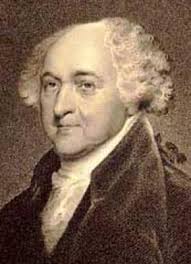
"Your university [of Virginia]is a noble employment in your old age and your ardor for its success does you honor but I do not approve of your sending to Europe for tutors and professors. I do believe there are sufficient scholars in America to fill your professorships and tutorships with more active ingenuity and independent minds than you can bring from Europe. The Europeans are all deeply tainted with prejudices both ecclesiastical and temporal which they can never get rid of. They are all infected with episcopal and presbyterian creeds and confessions of faith. They all believe that great Principle which has produced this boundless universe, Newton's universe and Herschell's universe, came down to this little ball to be spit upon by Jews. And until this awful blasphemy is got rid of, there never will be any liberal science in the world."
Our esteemed commenter JL Bell replies:
Looks to me like the “awful blasphemy” isn’t exactly the Trinity but the Incarnation—the idea that Jesus was [born] both divine and of human flesh.
Adams scoffed at the belief that the universe’s divine power (“that great Principle”) had become human (“down to this little ball”) and suffered for humanity (“spit upon by Jews“—not a metaphor for Jewish theology but an allusion to Jesus’s punishment and execution, as described in the Christian Gospels).
That's solid. But what of the rest? What the hell is Adams on about this time?
Adams' diary, April 24, 1756:
"...all the unnumbered Worlds that revolve round the fixt Stars are inhabited, as well as this Globe of Earth."
Aha. He's talking some serious E.T. here.
No, really---some serious ET, and it's not surprising.
The extraterrestrial thing had been in the air for at least a century. Life on other worlds would completely blow orthodox Christianity out of the water, or so men like John Adams believed.
The 18th century was a time of transition for the West, from a Christianized culture to a secularized culture. Deism, standing midway between Christianity and atheism, was the religion of transition.
To be more exact, deism was the religion of the Newtonians. At the end of the 17th century, Newton had used the materialist atomism, ultimately rooted in the thought of Epicurus and Lucretius, as a foundation for his geometrical account of nature. As a result, the closest Newton could come to Christianity was deism, in which a distant god created the atoms and gave them an initial shove. The Incarnation was simply jettisoned as cosmologically incompatible and therefore irrelevant.
Deist poet laureate Alexander Pope composed "The Universal Prayer," which praised the deist god as the creator of multiple worlds and was intended by Pope to replace the all-too-provincial Lord's Prayer. The works of the archdeist Voltaire, who called himself the new Lucretius, were shot through with multiple worlds peopled by extraterrestrials. On America's own shores, Benjamin Franklin included such cosmic pluralism in his personal articles of belief, even claiming that the plurality of extraterrestrials included a plurality of gods to watch over each of the suns.
Perhaps more clearly than anyone else of the time, the deist Thomas Paine realized that the existence of a multitude of worlds (and, thus, of extraterrestrials) was entirely incompatible with Christianity: "[T]o believe that God created a plurality of worlds at least as numerous as what we call stars, renders the Christian system of faith at once little and ridiculous and scatters it in the mind like feathers in the air." For those who attempted a reconciliation of such plurality with Christianity, Paine warned that "he who thinks that he believes in both has thought but little of either." Paine, convinced of plurality, chose deism.
Many eminent figures agreed. The existence of extraterrestrials made belief in the particularity of Christianity an embarrassment. The poet Percy Bysshe Shelley found it easy to believe in extraterrestrials but, as a consequence, "impossible to believe that the Spirit that pervades this infinite machine begat a son upon the body of a Jewish woman." John Adams wrote to warn Thomas Jefferson against hiring anyone at the University of Virginia who holds the "awful blasphemy" that the "great Principle which has produced... Newton's universe... came down to this little ball, to be spit upon by the Jews."
There's an irony there, that Adams is being as dogmatic about life on other worlds as those he condemns. But that's typical of Adams---as with his own unitarianism, his life's studies tended toward the confirmation of his earlier-in-life prejudices rather than a questioning of them. He left his "free inquiry" for ideas he'd already rejected, the ones he accepted were left unexamined.
But that's John Adams. In attempting to understand him as he understood himself, it seemed too sophisticated for him to be aware of Ørsted's proof of electro-magnetism or the influence of Kant and Schelling's philosophy on him.
On the other hand, it seemed too foolish for even John Adams to flatly exclude Trinitarians from being able to do good science. But in this one area, because of the theological forces aligned at that time, his criticism would be apt: Few if any European orthodox were open to a universe without the Incarnation at the center of it. There is no meaning or purpose to life without Christ.
As for Adams' speaking of the Jews "spitting on" Jesus, it has to be understood in terms of Adams' own non-Trinitarian Christianity, known as "unitarianism."
He wasn't a bigot, really, nor was he being hostile to the Jews here really. He was writing to Jefferson, who spoke of the Jews less kindly, and John Adams was more than a bit of a chameleon to his audiences.
Most interesting is a letter to a prominent Jew, Mordacai Noah, which reveals a bit of Adams' theological [if not sectarian] agenda, a commercial for Adams' own brand of Christianity, non-Trinitarian "Unitarian Christianity," which I feel comfortable putting under the umbrella of the clumsy term "Judeo-Christianity" in describing the God of the Founding:
I believe [that] . . . once restored to an independent government & no longer persecuted they [the Jews] would soon wear away some of the asperities and peculiarities of their character & possibly in time become liberal Unitarian Christians for your Jehovah is our Jehovah & your God of Abraham Isaac and Jacob is our God.
Add a little non-divine Jesus to Judaism, not be bigoted toward Jews for "spitting on Jesus," and we're all just one big happy "liberal" Unitarian Christian family.
That was John Adams, especially in his later life, after his public life. In the same year as this letter---all the sound and fury of his presidency, signifying nothing---and Adams himself described it that way, as a tale told by an idiot---had faded away from relevance and importance.
What was left, what Adams is saying here at the end of his 80th decade is that he's pretty deaf, denies he gives much of a damn whether his son John Quincy wins the upcoming Electoral College controversy that's been thrown into the House of Representatives, [still] hates religious authoritarianism, thinks the Jews might be OK with a little [but too much] of Christianizing [but need some Zionism], and he believes in E.T.
That's John Adams, folks.
I hope y'all will permit me to enter my own opinion of Mr. John Adams here, after all much frankly painful and careful and close reading of his writings---his own tale of his life and beliefs are those of an idiot told by an idiot. He was a good man, but a smallish man, not a great man---first clinging to his cousin Samuel Adams' coattails in igniting the American Revolution, then to George Washington's. When he was on his own, he destroyed Washington's Federalist party with his pettiness and the tyranny of the Alien and Sedition Acts, which permitted little political dissent, and downright made it illegal.
The American public couldn't wait to be done with him. Even his own party couldn't wait to be done with him, barely opposing Jefferson's takeover of the government.
Still, I like John Adams, irritating as he was to most everybody. We have that much in common, anywayz. But give me his son John Quincy anyday, who returned to the House of Representatives after he won, then lost, the presidency [yes, he won the election controversy of 1825, only to lose to Andrew Jackson in the rematch of 1830]; the John Quincy Adams who argued Amistad.
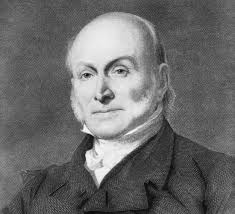
In that, John Adams truly fulfilled the American Dream: The father raised a better man than he. No higher praise could be given to any man.
[Or woman either, Abigail Adams. It takes two. But Abigail is yet another story, and she earns her own place in the history of America in her own right...]


0 Comments:
Post a Comment