Mark David Hall delivers to Heritage. This is good. I watched the whole thing and wanted to do it justice with a line by line commentary. But I've waited too long, after Dr. Hall graciously sent the link to me, so I reproduce it now.
Dr. Hall's perspective is more sympathetic to a "Christian America" reading than mine. He does outstanding work and understands the right questions (along with blogfellows Tom Van Dyke, John Fea and others).
Thursday, January 13, 2011
Mark David Hall on American Political Theology
Monday, December 27, 2010
Rodda On Beck U
A biggie from Chris Rodda. Lots to watch and read on this snowy day for those of us in the Northeast.
Friday, December 24, 2010
No, Mr. Beck, Our Constitution is Not Based on the Book of Deuteronomy
This is a good one from Chris Rodda. It makes an extremely important point on the Donald S. Lutz et al. study that bears repeating. I'll talk more about the Lutz study soon.
Thursday, December 23, 2010
The Reason For the Season
According to Dicken's A Christmas Carol was NOT Christ's Atonement or Incarnation but rather man's good works and good will. I reposted it at Brayton's blog here.
Saturday, December 18, 2010
Heads Up
I'll be guest blogging at Ed Brayton's Dispatches From the Culture Wars from Dec. 19-27. My grades (for 21 credits) are due Tuesday morning, so I'm not sure how much blogging I will do till then.
Monday, December 6, 2010
Waldron on Issues with Imago Dei
Jeremy Waldron is probably the foremost authority on the need to give human rights a theological grounding. This paper explores issues with using "Imago Dei" to ground human rights.
A taste:
Second, there are questions about what imago Dei means in the light of doctrine of the fall into sin. What is the relation between imago Dei and our fallen sinful nature? What can human rights theory do with Calvin’s doctrine that the image of God in us is now but a “relic” or Martin Luther’s teaching that since the Fall we are more “like” the devil than “like” or “in the image of” God? When we use this doctrine in the context of human rights, are we committing ourselves to saying that Luther and Calvin were wrong?
It's surprising how many otherwise informed and intelligent folks are so quick to conflate their theological desires with America's Founding Fathers. The syllogism works something like this:
1. The Bible/Christian Religion/Calvinism is true;
2. Therefore I am a reformed Protestant in that sense;
3. The American Founding was a great event, one in which I'd like to believe my personal religious tradition gave us;
4. Therefore, the political-theological basis for the American Founding must have been the same as Calvinism (or whatever my religion is).
This syllogism works with anyone's personal religion. Though the further one's personal religion from that of the actual American Founding, the more of a stretch it becomes.
For instance, beginning with "Hinduism is true" results in an especially absurd syllogism. But ultimately, the entire syllogism, no matter what one begins with is an error. As I've said before, the political theology of the American Founding offers a little for everyone (including the Hindus!) and a little for no one.
If one doesn't take one's personal religion that seriously, the syllogism seems a harmless error. The more seriously one takes one's religion and values it over politics, the more dangerous the syllogism. America's Founders could have been wrong on how they understood theology and how it ought to apply to politics. If they were wrong on Romans 13 (which there is good reason to believe, from a strict literal textual interpretation, they were) the Bible says, "they that resist shall receive to themselves damnation."
It's only your soul that is on the line. Don't let America's Founders, and your desire to claim them, confuse you into making a soul damning error.
Monday, October 25, 2010
The Tea Party and the Constitution: A Rebuttal
[A few days ago, American Creation posted "The Tea Party and the Constitution" by Joseph Moore, via friend-of-the-blog John Fea's The Way of Improvement Leads Home. Michael Makovi, an American student in Jerusalem, offered this rebuttal there, which we are pleased to reprint here in longer form, with his permission.---TVD]
by Michael Makovi
Guest Blogger
I. General Historical and Ideological Context
 Joseph Moore's argument is that the Constitution was meant to limit populist movements like the Tea Party, and that the Tea Party has more in common with the Anti-Federalists than with the Federalists:
"The Constitution was written to constrain movements like the Tea Party. Ironic, then, that Tea Partiers espouse such a religious reverence for it. ... The paradox of this crusader's zeal for the Founding Fathers is that the Tea Party more closely resembles the groups that opposed the Constitution than those who wrote it in 1787. ... The Constitution was written to protect government from movements like the Tea Party. It was written to ensure the power of the federal government to direct economic policy. It was written to keep control away from angry men with guns. It was, in short, everything Tea Party advocates like Beck and Michael Savage think it was not."
Moore concludes that the Tea Party is voicing historically-legitimate views (those of the Anti-Federalists), but is confused, in that it's relating itself, wrongly, to the Constitution:
"Ironically, the Tea Partiers have embodied what their most sacred text opposed. This does not delegitimize them.They stand in a meaningful tradition even as they misunderstand it. They have channeled the old angst of Anti-Federalism, good and bad, into the present by combining Jeffersonian fear of government with anger for anger's sake. Their zeal is both tremendous and historic."
However, I think Moore needs to view this whole matter in greater historical perspective. Yes, the Tea Party might very well be more like the Anti-Federalists than like the Federalists, but if we compare them both together with other political philosophies, then we see they are both of the same classical liberal, constitutionalist, limited government school. The Anti-Federalists and the Federalists were both two different opposing factions of the same general school of thought. Had Moore studied these two factions against the backdrop of the entire history of the classical liberal and federal traditions, he would have seen how similar the Federalists and the Anti-Federalists really were.
In fact, most of the differences between the two come down to mere tactics; i.e., they differed not on the theory, but on how to enshrine that theory in practice. It is one thing to believe in limited government and social contract, but it is something else to determine how to put those into effect, and the Anti-Federalists and Federalists mostly disagreed merely on practice, not on theory.
And whatever theoretical differences they did have, were relatively minor when put into a greater perspective. The Federalists, like the Anti-Federalists, also feared that a strong government would take away their freedoms. After all, that is exactly why the American Revolution was fought. The Federalists may not have been as libertarian as the Anti-Federalists, but they weren't Tories!
We cannot have such a myopic and narrow view of history. The American Revolution cannot be viewed in isolation. It must be viewed alongside the Dutch, English, and French Revolutions, and viewed as the sequel to the first two that it truly was. The cartoon
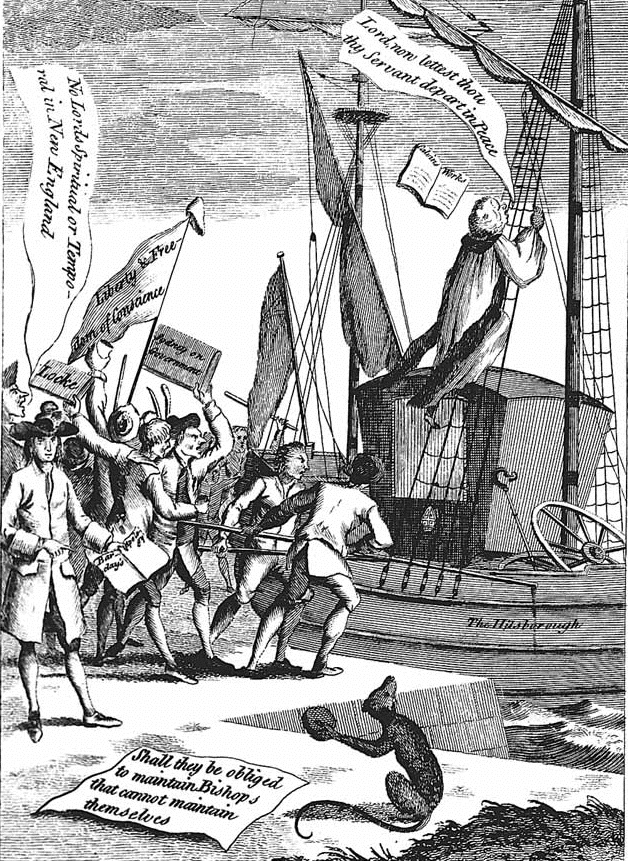 "An Attempt to Land a Bishop in America" depicts John Calvin and Algernon Sidney as being partners of John Locke, while John Adams said John Ponet's work contained "all the essential principles of liberty, which were afterward dilated on by [Algernon] Sidney and Locke". John Adams additionally recommended the anonymous Vindiciae Contra Tyrannos. I'm sure we all know who Calvin was, while John Ponet was a Protestant Christian during the persecutions of Protestants by Mary Tudor (Bloody Mary), the Vindiciae Contra Tyrannos was a Huguenot tract, and Sidney was a partner of Milton and Cromwell. In other words, the American Revolution was part of the general Reformed Christian movement of federalism and limited government that was behind the Dutch and English revolutions, and we must study it as part of that movement, not in isolation. And this Reformed Christian movement was closely related to the Whig and classical liberal tradition. After all, Locke's father fought under Cromwell, and Locke was familiar with Puritan and Congregationalist trends in England, and the two traditions remained very closely allied to each other. Analyzing Francis Schaeffer's claim that John Locke relied on Samuel Rutherford, Robert Arnold concluded that while there is no evidence that Locke utilized Rutherford, that nevertheless, Locke certainly relied on those who were part of Rutherford's same Reformed Christian school of thought, such as Milton. Indeed, let us also note that the Mayflower Compact displays a mature social contract theory decades before Locke was even born. Locke may be the most famous exponent of social contract theory, but he was not the first.
II. The Bill of Rights
And we should not mischaracterize the Bill of Rights, as I believe Moore does:
"The original Constitution did not include the rights to free speech, religious choice, bearing arms, due process, or trial by jury. ... Along the way the Anti-Federalists browbeat ten notable concessions called the Bill of Rights out of Washington and 'the establishment.'"
Is it really reasonable for us to imagine that the Federalists had no concern whatsoever for limited government and the securing of basic rights? Even if the Constitution said nothing, what about the Magna Carta, the Petition of Right (1628), and the English Bill of Rights (1689), not to mention the Declaration of Independence? After all, the Declaration of Rights of 1765 asserted
That his majesty’s liege subjects in these colonies, are entitled to all the inherent rights and liberties of his natural born subjects, within the kingdom of Great Britain.
Similarly, the Declaration of Rights and Grievances of 1774 claimed,
"That the inhabitants of the English Colonies in North America, by the immutable laws of nature, the principles of the English constitution, and the several charters or compacts, have the following Rights."
So even if the Constitution says nothing, the Magna Carta (or rather, the Whig hagiography that grew up around it) ought to suffice. More importantly, when the Anti-Federalists asked for a Bill of Rights, the Federalists did not respond that men lack rights to freedom of speech, to bear arms, and such. Rather, they responded that a Bill of Rights would imply that any rights not listed were not to be protected. In other words, it was a legal/exegetical/hermeneutical dispute, not an ideological one. The Federalists had no disagreements with the substance of the Bill of Rights as demanded by the Anti-Federalists, but were afraid that explicitly listing those rights would disparage those rights not listed. The Federalists, as much as the Anti-Federalists, were part of the classical liberal tradition, and believed that all men are created by God, and as such, have the rights to speak freely and bear arms, and that the government is created by social contract and has only those powers delegated by the people.
III. Economic Policy
It may very well be, as Moore says, that the Constitution
"was written to ensure the power of the federal government to direct economic policy."
But even Federalists would be aghast at how the Commerce and General Welfare Clauses have been interpreted. Given the fundamentally illiberal government we have today, the differences between the Federalists and the Anti-Federalists pale in comparison. Even a Federalist would say that the Commerce Clause was meant to prevent trade wars among states and that the General Welfare Clause was meant to protect the general welfare as opposed to parochial, sectarian welfare of select factions. If anything, the Federalists would be more upset than the Anti-Federalists! After all, the Anti-Federalists could always say, "I told you so. This is why I wanted us to stick to the Articles." But the Federalist had just spent so much time carefully crafting the Constitution, only for the New Deal court to come along and declare that the Commerce and General Welfare Clauses were carte blanches, and that the whole rest of the Constitution was literally useless and meaningless. So much toil and sweat and ink, for naught!
In the comments to Moore's original posting at The Way of Improvement Leads Home, I value Paul M.'s observations about Keynesianism and Shays's Rebellion. But he makes the same mistake as Moore when he says,
It is very ironic that the Tea Party movement has embraced a document designed as a check on individual liberties and local and state autonomy. ... Isn't it amazing that the scope of the federal government has become so extensive as to make the Constitution a check on federal authority rather than the expansion it was originally intended to be?
IV. Mindset, Worldview, and Intention of the Tea Party
Moore goes on to say
"They collapse evangelical views on the Bible (as written by divinely inspired men and therefore inerrant) into conservative views of the Constitution (same, same). When faced with problems, Glenn Beck proclaimed to a group of kids this summer, "The answer is always 'restore the Constitution.'" In August, a Greensboro crowd carrying weapons met for a "Restore the Constitution" rally. they have turned 'don't tread on me' into 'don't tread on the Constitution.'"
But I believe that the Tea Party's advocacy of loyalty to the Constitution is not so much a religious worship of the Constitution per se, as much as it is instead that:
- The Constitution is what we already have. Anyone concerned with the rule-of-law and federalism (meaning "covenantalism", i.e. social contract) is going to advocate loyalty to the Constitution not only because of its intrinsic value and goodness, but simply because it is what is already on the law-books; the libertarian will demand observance of the Constitution not only because it is intrinsically good, but simply because the rule-of-law demands it. Even if the Anti-Federalist would say the Constitution is evil, it is at least lawful evil.
2. The Constitution enshrines principles greater than itself. The Constitution is a specific instance of federalism (social contract), and so anyone who supports federalism in general - i.e. classical liberals and libertarians - is going to see the Constitution as a good approximation of what they seek. It does not mean the Constitution is perfect, but it is among the closest things to perfection in today's world. It provides a good starting point, and once we reinstate it as the lawful king that it ought to be, then we can talk about improving on it. Those who advocate adherence to the Constitution are likely planning on moving past the Constitution, towards a more completely libertarian government, but they rightly see the Constitution as a step in that direction.
So when Tea Partiers advocate adherence to the Constitution, they do this instead of advocating for the Articles of Confederation because (respectively):
To summarize my argument, I believe Moore takes too narrow a view of history when he says the Tea Party is like the Anti-Federalists and thus should be opposed to the Constitution. I believe that he has overstated the differences between the Anti-Federalists and the Federalists, and the Articles and the Constitution, because his chosen time-span of history is too small.
[Michael Makovi is an Orthodox Jewish student studying in Jerusalem, and is originally from Silver Spring, MD. Mr. Makovi's focus is on political philosophy, with a special interest in Reformed Christian sources of libertarianism. His personal blog is here.]
Sunday, September 12, 2010
Tempest at Dawn: Who Wrote the US Constitution?
[I recently had the pleasure of reading Jim Best's historical novel about the framing of the Constitution, and a glowing review is forthcoming. In the meantime, while you're waiting for your copy to arrive after you've ordered it here, a few words from Mr. Best himself. Enjoy.---TVD]
by James D. Best
Guest Blogger
"The infant periods of most nations are buried in silence, or veiled in fable, and perhaps the world has lost little it should regret. But the origins of the American Republic contain lessons of which posterity ought not to be deprived."—James Madison
The Articles of Confederation proved barely adequate during the imperative of war and a failure after independence. It looked as if the American experiment was doomed. Then in May of 1787, delegates came to Philadelphia with a congressional charter to revise the Articles of Confederation. They didn’t revise the Articles. Instead, they wrote a constitution from scratch for a totally new government. These men carried out a bloodless coup that replaced an existing government without a shot.
Who were these men? Who wrote the Constitution of the United States?
The short answer is that Gouverneur Morris wrote the Constitution, with editing help from other members of the Committee of Style. In truth, all of the delegates, to a greater or lesser degree influenced the substance of the Constitution. There were fifty-five men that attended the Federal Convention, what we now call the Constitutional Convention. When Thomas Jefferson read the list of attendees, he called them an “assembly of demi-gods.”
Not exactly, but they were staunch revolutionaries and patriots. They were also highly successful, well educated, and unswerving in their support of the republican form of government. They came to Philadelphia committed to rescuing American from its slide into anarchy.
A few are household names. George Washington presided over the convention. James Madison, Roger Sherman, Benjamin Franklin, Alexander Hamilton, James Wilson, and George Mason were all key delegates. Many of the rest have been forgotten.
Most of these men knew each other from years of politicking or war. Twenty-nine served in a military capacity during the Revolution and another twenty-three risked their fortunes and lives by taking an active political role during the war. Eight committed treason by signing the Declaration of Independence.
In colonial America, college degrees were rare, yet twenty-nine held college degrees and many others were self-educated in the classics and modern political thought. Almost all of the delegates were knowledgeable about Aristotle, Locke, Hume, and Montesquieu. Ten had degrees from the College of New Jersey (later to become Princeton), six from European universities, four from Harvard, four from Yale, four from William and Mary, two from the College of Philadelphia, and one from Kings College (later to become Columbia University).
Forty-five delegates were rich. Thirty-one had the good fortune of being born to wealthy or prominent families. Twelve were self-made and two married into money. Ten struggled to make ends meet and to support their families. Eight were born in other counties and many were second generation. Eleven were businessmen, eight owned large plantations, three were physicians, one was a professor, and six could be called professional politicians.
Thirty of the delegates were lawyers in an age that revered the rule of law and reason. All of them had extensive political experience and many went on to take substantial roles in the government they created. Two became president, twenty-five served in Congress, five gained appointments to the Supreme Court, four became foreign ministers, and four held cabinet positions.
Not every delegate went on to further success. Six wealthy delegates died impoverished, fleeing creditors. One was indicted, but not tried, for treason. One barely escaped impeachment from the Supreme Court and another was expelled from the Senate. Two died in duels, another mysteriously disappeared in the middle of New York City, and another was rumored murdered by a grandnephew impatient for his inheritance.
These were not demi-gods, but real men with human frailties and weaknesses. The story of the Constitution’s creation is incredible, but what makes this work as a novel is the cast of characters. The Founding Fathers were bigger than life, but they were also real human beings—--men and women that I wanted to bring into the reader’s living room.
It was fun getting to know them as I researched and wrote Tempest at Dawn—well, all of them except for possibly Elbridge Gerry.---JDB
http://www.jamesdbest.com/

Tuesday, August 10, 2010
Saturday, July 31, 2010
Tuesday, July 20, 2010
Mark David Hall: The Influence of the Reformed Tradition on the American Founding, Part VIII (Final)
By Mark David Hall
The First Amendment
America’s founders differed with respect to whether and/or how civic authorities should support Christianity. On balance, Reformed Christians were more sympathetic to significant state support for religion, as suggested by the survival of establishments in Vermont (1807), Connecticut (1819), New Hampshire (1819), Maine (1820), and Massachusetts (1833). Yet when Supreme Court Justices have turned to founding era history to shine light on the meaning of the religion clauses, they have overwhelmingly relied on the views of two Southern Anglicans—Thomas Jefferson and James Madison. This approach is particularly ahistorical as Jefferson was not even involved in crafting or ratifying the First Amendment.
In contrast to Jefferson, Roger Sherman—a latter-day Puritan if there ever was one—was intimately involved in framing the First Amendment. Sherman served on the committee of eleven that compiled the list of rights first debated by the House of Representatives (the only handwritten draft of the Bill of Rights is in his hand), he actively participated in debates over the amendments, and he served on the six-person conference committee that put the Bill of Rights into its final form. On some issues, such as whether amendments should be interspersed throughout the Constitution or attached to the original text, Congress sided with Sherman rather than Madison. Given Sherman’s extensive involvement in drafting the First Amendment and Jefferson’s absence from the country at the time, it is striking that when U.S. Supreme Court justices have used history to help them interpret the First Amendment’s religion clauses that they have made 112 distinct references to Jefferson but have mentioned Sherman only 3 times.
James Madison may have been a driving force behind the Bill of Rights, but the document was ultimately a product of a community—a community that included the following members of Reformed churches: Roger Sherman, Oliver Ellsworth, John Langdon, Caleb Strong, Paine Wingate, Philip Schuyler, Abraham Baldwin, Jonathan Elmer, William Paterson, Fisher Ames, Abiel Foster, Benjamin Huntington, James Jackson, Jeremiah Wadsworth, Nicholas Gilman, Egbert Benson, James Schureman, Henry Wynkoop, Daniel Hiester Jr., Daniel Huger, Benjamin Bourne, William Paterson, William Smith, and Hugh Williamson. Certainly these men were not all equally influential, but at least Sherman, Ellsworth, Huntington, Baldwin, Boudinot, Paterson, and Ames played important roles in key committees and/or debates. None of these seven men advocated anything like a wall of separation of between church and state, and they all thought that states and localities state should encourage Christianity. They agreed with their colleagues that the nation should not have an establish church, but even at the national level they supported things like hiring congressional and military chaplains and requesting that President Washington issue a Thanksgiving Proclamation.
Conclusion
Students of the American founding often view the era through the eyes of elites such as Thomas Jefferson, James Madison, George Washington, Alexander Hamilton, Thomas Paine, Benjamin Franklin, and John Adams. These men were brilliant, well educated, and influential, but they are not are good representatives of the many Americans who were associated with Reformed congregations in the founding era. Franklin and Adams, the only founders in this group who were raised in the Reformed tradition, clearly came to reject the basic tenets of orthodox Christianity—something that was quite rare for any American of that era. Yet even among in this small, unrepresentative group a reasonable argument can be made that at least some of these men (most obviously Adams and Madison) were influenced by Reformed political ideas.
Tracing intellectual influence is a messy business. Different people may express similar ideas for completely different reasons, or they may use similar words but mean different things by them. Even within the realm of Christianity members of different denominations may adhere to similar ideas, so it is problematic to label almost as distinctively Reformed. Yet if we recognize that Calvinists shared a basic set of political ideas, and that a large majority of Americans were raised in this tradition, it is only reasonable consider the impact of this tradition on America’s founders. I suggest above how taking this tradition seriously might help qualify the widespread view that the Declaration, Constitution, and First Amendment are fundamentally secular documents.
Let me reiterate that I am not arguing that America’s constitutional order is simply and solely a product of Reformed political thought. There were clearly other intellectual influences at work in the era, and founders often acted for non-ideological reasons. As well, although the Reformed tradition was dominant in New England, it was less influential in the middle and southern colonies. My point is simply that there are good reasons to believe that many founding era Americans were committed to and influenced by Reformed political thought. If scholars can pull their eyes away from indisputably fascinating men like George Washington, John Adams, James Madison, Thomas Jefferson, Alexander Hamilton, Thomas Paine, and Benjamin Franklin and consider the many members of the Continental Congress, Constitutional Convention, and First Federal Congress who were relatively drab Calvinists, they will gain a fuller and richer understanding of this critical era in American history.
Notes:
67. It is sometimes asserted that Jefferson’s Virginia Statute for Religious Liberty influenced the authors and ratifiers of the First Amendment. I argue that there is little evidence to support this proposition in “Madison’s Memorial and Remonstrance, Jefferson’s Statute for Religious Liberty, and the Creation of the First Amendment” (mss. in possession of author).
68. Mark David Hall, “Jeffersonian Walls and Madisonian Lines: The Supreme Court’s Use of History in Religion Clause Cases, Oregon Law Review 85 (2006): 568-69. Of course Reformed Christians often opposed established churches if their churches were not established, but even then they seldom supported a strict separation between church and state. See, for instance, Thomas E. Buckley, Church and State in Revolutionary Virginia, 1776-1787 (Charlottesville: University Press of Virginia, 1977).
69. Dreisbach and Hall, Sacred Rights of Conscience. 426-433, 441-87; Dreisbach, Hall, and Morrison, The Forgotten Founders on Religion and Public Life, 65-100, 248-277 (on Sherman and Ellsworth), Dreisbach and Hall, Faith and the Founders of the American Republic (on Baldwin and Boudinot), John E. O’Connor, William Paterson: Lawyer and Statesman, 1745-1806 (New Brunswick: Rutgers University Press, 1986); Marc M. Arkin, “Regionalism and the Religion Clauses: The Contribution on Fisher Ames,” Buffalo Law Review 47 (Spring 1999), 763-828. Charlene Bangs Bickford et al., ed. Documentary History of the First Federal Congress (Baltimore: The Johns Hopkins University Press, 1992), 11: 1500-01
Friday, July 9, 2010
Mark David Hall: The Influence of the Reformed Tradition on the American Founding, Part VI
By Mark David Hall
Case Studies
Because scholars and popular writers have tended to focus on founders who were not part of the Reformed tradition, and because they often simplistically attribute any reference to natural rights, government by consent, and the right to resist tyrannical authority to a secularized Locke, they have neglected the influence of Calvinist political thought on the American founders. However, if we take the tradition seriously and look beyond a few elite founders, a fuller and richer picture of the founding comes into focus. Within the academy, historians have done a better job of doing this than have political scientists and law professors. The latter two groups are far more likely to focus on a few texts such as the Declaration of Independence, the Constitution, The Federalist Papers, and the Bill of Rights. Moreover, they tend to interpret public documents in light of the privately held views of a few elites rather than as a product of a community—for our purposes a community that included a significant number of Reformed Christians. In the following sections I indicate ways that taking this tradition seriously can help scholars better understand texts such as the Declaration, Constitution, and Bill of Rights. Each study is necessarily brief and is meant only to be suggestive.
The Declaration of Independence
The War for Independence involved a variety of issues, but particularly relevant for Reformed Americans were concerns that Parliament and the Crown intended to restrict the colonists’ freedom of worship. Notably, they worried that the King planned to appoint a bishop for the American colonies. The Puritans and their descendents had always been in the precarious position of maintaining what was in effect a dissenting establishment. They feared that a bishop would attempt to take over all colonial churches and set up oppressive ecclesiastical courts. The most recent episode in the long-running pamphlet war concerning an American episcopate had erupted in 1763. Two years later, Parliament passed the Stamp Act, which contained a reference to courts “exercising ecclesiastical jurisdiction within the said colonies.” This was taken by partisans of both sides to imply that a bishop would be sent shortly, and that for the first time ecclesiastical courts would operate in the American colonies.
These fears may seem excessive today, but to an eighteenth century Calvinist they made perfect sense. Calvinists had often struggled against unfriendly governments, and New England Puritans had come to America precisely because they were unable to reform completely the Church of England. Throughout the eighteenth century some American Anglicans continued to argue that the Congregationalist and Presbyterian churches were not “true” churches because their ministers had not been ordained by bishops. The extent to which Anglican leaders supported the plans of American Anglicans has been extensively debated by scholars; but there is little reason to doubt that Reformed Christians genuinely feared an Anglican episcopate. Ill-conceived actions by the Church of England such as founding a “mission” in Cambridge, Massachusetts in 1759 did little to calm their fears.
Calvinists in America were also troubled by the Quebec Act of 1774. From Parliament’s perspective, this innocuous piece of legislation simply provided for the efficient governing of territory won from France after the French and Indian War. The act extended the colony of Quebec into what is now the American midwest, permitted the use of French civil law, and allowed Catholics to freely practice their faith and take oaths without reference to Protestantism. To many Protestants, these steps constituted a significant retreat for the kingdom of God in North America. Reformed Protestants of the era considered Roman Catholics to be, at best, seriously deceived and, at worst, in league with Satan. Expanding territory controlled by “Papists” and giving them full civil rights did not bode well for the Protestant cause.
Reformed Christians had long been on their guard against tyrannical rulers desiring to stamp out the true gospel. Although they recognized that God is sovereign, they were haunted by events such as the massacres of French Huguenots, where evil rulers seemed to succeed. When tyrannical rulers had failed it was, from a human perspective, because Protestants had resisted them with arguments, laws, and force. As Reformed Americans began to perceive a pattern of tyranny by Parliament and the Crown, they reacted forcefully against the threat.
The influence of Reformed political ideas on American Patriots is often ignored because students of the era focus on the Declaration of Independence as the statement of why separation from Great Britain was justified. Moreover, they read the document in light of the views of its primary drafter, Thomas Jefferson, who was more influenced by the Enlightenment than virtually any other American. The Declaration of Independence is compatible with the Reformed political theory, but this tradition’s influence is more evident in other public documents stating the Patriots’ case. These texts are not narrowly Reformed—indeed, they might be better characterized as articulating Protestant concerns. However, a large majority of Protestants in America at the time were, in fact, Reformed Protestants, and these Protestants were more likely to support the Patriot cause and use such language than, say, Anglicans.
On September 17, 1774 Paul Revere delivered the Suffolk Resolves to the Continental Congress. The Resolves recognized the sovereignty of King George, but challenged the legality of recent acts and practices by the British Parliament. The Resolves proclaimed[t]hat it is an indispensable duty which we owe to God, our country, ourselves and posterity, by all lawful ways and means in our power to maintain, defend and preserve those civil and religious rights and liberties, for which many of our fathers fought, bled and died, and to hand them down entire to future generations.
As well, they condemnedthe late act of parliament for establishing the Roman Catholic religion and the French laws in that extensive country, now called Canada, is dangerous in an extreme degree to the Protestant religion and to the civil rights and liberties of all America; and, therefore, as men and Protestant Christians, we are indispensably obliged to take all proper measures for our security.
The Suffolk Resolves played a significant role in encouraging congressional delegates to take a strong stand against Parliament. Shortly after receiving the Resolves they adopted a “Declaration of Rights” that asserted the colonists’ constitutional and natural rights. They objected specifically to the act passedfor establishing the Roman Catholick Religion in the province of Quebec, abolishing the equitable system of English laws, and erecting a tyranny there, to the great danger, from so total a dissimilarity of Religion, law, and government of the neighbouring British colonies, by the assistance of those whose blood and treasure the said country was conquered from France.
Congress’s “Appeal to the People of Great Britain,” approved at the same time, expanded on the significance of the Quebec Act and challenged Parliament’s ability “to establish a religion, fraught with sanguinary and impious tenets, or, to erect an arbitrary form of government, in any quarter of the globe.” These and other congressional documents highlight concerns that are only vaguely represented in the Declaration of Independence’s charge that the king abolished “the free System of English Laws in a neighboring Province…” The difference has something to do with the person who drafted the latter document, but even more to do with the intended audience. Jefferson was obviously not in the Reformed tradition, and a critical audience for the Declaration was Roman Catholic France. The eventual intervention of France on the Patriots’ side did much to diminish the vehement anti-Catholicism of many Americans in this era, but suspicion of “papists” remained a powerful force in the American imagination well into the twentieth century.
Like the Declaration of Independence, Congress’s 1775 “Declaration on Taking Arms” makes broad theoretical claims about natural rights, the necessity of consent, and the ends of government; but it communicates these claims in powerful religious rhetoric. Originally drafted by Jefferson, it was revised significantly by John Dickinson and then debated and approved by Congress. The document began by arguing that if:it was possible for men, who exercise their reason, to believe, that the Divine Author of our existence intended a part of the human race to hold an absolute property in, and an unbounded power over others, marked out by his infinite goodness and wisdom, as the objects of a legal domination never rightfully resistible, however severe and oppressive, the inhabitants of these Colonies might at least require from the parliament of Great Britain some evidence, that this dreadful authority over them, has been granted to that body. But a reverence for our Creator, principles of humanity, and the dictates of common sense, must convince all those who reflect upon the subject, that government was instituted to promote the welfare of mankind, and ought to be administered for the attainment of that end.
This paragraph reflects well some of the basic tenets of Reformed political theory. God is the author of freedom, and He ordains limited governments to promote the common good. The document goes on to proclaim that Parliament’s actions must be resisted, not because of the particular harm of any one policy but because its ultimate aim is to enslave the colonies. Congress emphasized Parliament’s overreaching claims, particularly its extravagant assertion that it could “make laws to bind us IN ALL CASES WHATSOEVER.” After listing a number of specific grievances against Parliament and the King, the delegates proclaimed that:With hearts fortified with these animating reflections, we most solemnly, before God and the world, declare, that, exerting the utmost energy of those powers, which our beneficent Creator hath graciously bestowed upon us, the arms we have been compelled by our enemies to assume, we will, in defiance of every hazard, with unabating firmness and perseverence, employ for the preservation of our liberties; being with our [one] mind resolved to die freemen rather than to live slaves.
This declaration, passed a little less than a year before its more famous cousin, falls short of requiring separation from Great Britain. Instead, it concludes “[w]ith an humble confidence in the mercies of the supreme and impartial Judge and Ruler of the Universe, we most devoutly implore his divine goodness to protect us happily through this great conflict, to dispose our adversaries to reconciliation on reasonable terms, and thereby to relieve the empire from the calamities of civil war.” It is interesting for our purposes because it more obviously reflects the concerns and language of Reformed Protestants. It is noteworthy that the text is seldom cited by scholars attempting to understand the ideological influences on America’s founders in this era.
On July 4, 1776 Congress approved the Declaration of Independence. Its most famous lines proclaim thatall men are created equal; that they are endowed by their Creator with certain unalienable rights; that among these are life, liberty, and the pursuit of happiness; that, to secure these rights, governments are instituted among men, deriving their just powers from the consent of the governed; that whenever any form of government becomes destructive of these ends, it is the right of the people to alter or to abolish it, and to institute new government, laying its foundation on such principles, and organizing its powers in such form, as to them shall seem most likely to effect their safety and happiness.
These words reflect arguments long made by Patriots, relatively few of whom read Locke and many of whom were active Calvinists. Of course their primary drafter, Thomas Jefferson, definitely read Locke and was most certainly not a Calvinist, but he later noted that he was not attempting to “find out new principles, or new arguments” and that the Declaration’s authority rests “on the harmonizing sentiments of the day.” Jefferson indisputably borrowed language from Locke, but the ideas to which he referred predated Locke by years. There is simply no evidence that signers from Reformed backgrounds such as Josiah Bartlett, William Whipple, Matthew Thornton, John Hancock, Samuel Adams, John Adams, Robert Treat Paine, William Ellery, Roger Sherman, William Williams, Samuel Huntington, Oliver Wolcott, William Floyd, Philip Livingston, Richard Stockton, John Witherspoon, John Hart, Abraham Clark, James Smith, James Wilson, Thomas McKean, and Lyman Hall understood the “Creator” to be “nature” or thought they were approving a document that mandated a “secular politics” as some scholars have claimed.
With the exception of John Witherspoon, no active clergyman is listed above. Yet observers have long recognized that Reformed ministers were among the most important supporters of the Patriot cause. The Loyalist Peter Oliver railed against “Mr. Otis’s black Regiment, the dissenting Clergy, who took so active a part in the Rebellion.” King George himself reportedly referred to the War for Independence as “a Presbyterian Rebellion,” and historians have recognized that there was an “almost unanimous and persistent critical attitude of the Congregational and Presbyterian ministers toward the British imperial policy.” Indeed, before real bullets were exchanged at Lexington and Concord the Congregationalist minister Jonathan Mayhew fired “the MORNING GUN OF THE REVOLUTION, the punctum Temporis when that period of history began.” The gun in question was Mayhew’s influential sermon “A Discourse Concerning Unlimited Submission and Non-Resistance to the Higher Powers” delivered and published in Boston in 1750. The sermon powerfully and eloquently argued that governments are ordained by God, that their powers are limited, and that citizens have a duty to resist rulers who do evil. Mayhew is not a good representative of Calvinist theology, but his sermon is an excellent example of Calvinist political thought. And it is only one of many sermons preached, printed, and circulated that encouraged Reformed Christians to be wary of and to resist tyrannical governments.
With a handful of exceptions such as the Swiss born Presbyterian John Joachim Zubly and a few Old Light Dutch Calvinists and Congregationalists, Reformed clergy were unanimous in their support of the Patriot cause. Most of their parishioners were as well. It should come as no surprise that men and women rooted in the Reformed political tradition, a tradition that had long held that individuals possess natural rights, that governments should be based on the consent of the government, that civil authority should be limited, and that the people have a right to overthrow tyrannical regimes would join the Patriot cause. From the English perspective, British Major Harry Rooke was largely correct when he confiscated a presumably Calvinist book from an American prisoner and remarked that “[i]t is your G-d Damned Religion of this Country that ruins the Country; Damn your religion.”
Notes:
51. For an argument that political theorists should be interested in the views of non-elites see Shain, Myth of American Individualism, 6-8 and Donald Lutz, A Preface to American Political Theory (Lawrence: University Press of Kansas, 1992), passim.
52. Carl Bridenbaugh, Mitre and Sceptre: Transatlantic Faiths, Ideas, Personalities, and Politics: 1689-1775 (New York: Oxford University Press, 1962), 207-87, 256; Frohnen, American Republic, 110.
53. Bernard Bailyn, The Ideological Origins of the American Republic (Cambridge: Harvard University Press, 1967), 95-96; Heimert, Religion and the American Mind, 351-52; Bridenbaugh, Mitre and Sceptre.
54. Kidd, The Protestant Interest; Martin I. J. Griffin, ed., Catholics and the American Revolution (Rideley Park: self-published, 1907), 1: 1-40; 3: 384-92.
55. Journals of the Continental Congress, 1774-1789, ed. Worthington C. Ford et al. (Washington, D.C., 1904-37), (hereinafter JCC), 1: 33-35
56. Adams, ed. Works of John Adams, 2: 16; JCC, 1: 68-70, 72.
57. JCC, 1: 83, 87-88. On the decline of anti-Catholicism in the era see Charles P. Hanson, Necessary Virtue: The Pragmatic Origins of Religious Liberty in New England (Charlottesville: University Press of Virginia, 1998
58. JCC, 2: 140-41, 146, 150-55, 157. Of course Christians from a variety of backgrounds could assent to the paragraph quoted above, and Dickinson came from a Quaker background.
59. Koch and Peden, Life and Selected Writings of Thomas Jefferson, 24.
60. Thomas Jefferson to Henry Lee, May 8, 1825, in Ibid., 656-57; Zuckert, Natural Rights Republic, 76, 141. Of course some of the founders listed above (and in the following lists) were better Calvinists that others—i.e. John Adams was a life-long Congregationalist, but privately he came to embrace Unitarian theology. On the other hand, he specifically claimed to be heavily influenced by Reformed political theory (supra, 20-21). As well, some joined other denominations later in life (e.g. Wilson eventually became an Anglican). I have compiled each list of Reformed founders myself, but where possible I list a printed account of the denomination affiliation of the founders. Lists commonly available on the internet are generally accurate but often contain mistakes. William Stevens Perry, “The Faith of the Signers of the Declaration of Independence,” Magazine of History (1926), 215-37.
61. Peter Oliver’s Origin and Progress of the American Rebellion, ed. Douglass Adair and John A. Schutz (Stanford: Stanford University Press, 1961), 41; Paul Johnson, A History of the American People (New York: HarperCollins, 1997), 173; Baldwin, New England Clergy, 91; John Wingate Thornton, ed., The Pulpit of the American Revolution 2nd (Boston: D. Lothrop, 1876), 43; and Sandoz, Political Sermons, passim.
62. Randall M. Miller, ed., “A Warm and Zealous Spirit”: John J. Zubly and the American Revolution (Macon: Mercer University Press, 1982); Leiby, The Revolutionary War in the Hackensack Valley, esp. 20-25; Mark A. Noll, Christians in the American Revolution (Washington, D.C.: Christian University Press, 1977), 120-21. Oscar Zeichner estimates that only 8% of adult males in Connecticut were Loyalists—and that most of these were Anglicans who lived in the western part of the colony. Zeichner, “The Rehabilitation of Loyalists in Connecticut,” The New England Quarterly 11 (June 1938), 308-309. John Leach, “A Journal Kept by John Leach, During His Confinement by the British, In Boston Gaol, in 1775,” The New England Historical and Genealogical Register 19 (1865), 256. This is not to say that all Patriots who were members of Reformed congregations were motivated by religion or Calvinist political thought. Ethnicity, interests, and other factors wholly unrelated to the Reformed tradition undoubtedly played a role with some individuals and groups. Tiedemann, “Presbyterianism and the American Revolution” (quoting additional contemporary sources blaming Presbyterians for the war), esp. 311-313.
Wednesday, July 7, 2010
More From DG Hart on Lillback
Here. Dr. Hart cites my American Creation co-blogger Brad Hart, but mistakenly calls him a "history professor." If Brad's writing can fool an eminent scholar like DG Hart, he must be doing something right.
George Washington was not an evangelical Christian -- Lillback admits that. Lillback is a leader in and a scholar of reformed Calvinistic theology. Lillback's dilemma is that he wants to claim someone with whom he admittedly has religious differences. So he'll concede only when it's so obvious and otherwise interpret the facts to fit his happy ending.
For instance, in 20,000 pages of recorded words of GW, the words "Jesus Christ" are found once, and one other time JC is mentioned by example, not name. Neither of which are written in GW's hand, but by an aide and both of these are in public addresses. In all of his many private letters, though "Providence" and other generic God words are mentioned very often, the name or person of Jesus is not mentioned ever. You never see "Father, Son, Holy Spirit," from GW's words. And the one time "Redeemer" is mentioned, it's from an address by the Continental Congress that GW had reproduced for his troops.
This dynamic, at the very least, proves GW was not an evangelical. But Lillback spins it as GW was a low church latitudinarian orthodox Trinitarian Anglican and claims it the custom of them not to mention Jesus. Well, they may not have talked about Jesus as much as the evangelicals did, but they didn't systematically avoid talking about Jesus, as though they had no relationship with Him like GW did. GW, from what we can tell, rarely had Jesus on his mind.
Friday, July 2, 2010
Notes on The Mayflower Compact
by Jeremy Dupertuis Bangs
[Friend-of-the-blog Dr. Jeremy Dupertuis Bangs, author of the new Strangers and Pilgrims, Travellers and Sojourners---Leiden and the Foundations of Plymouth Plantation, sends along a comment on Mark David Hall's most recent installment of his upcoming paper The Influence of the Reformed Tradition on the American Founding:]
Mark David Hall quotes the Mayflower Compact thus: "the Mayflower Compact, committed the people and the rulers to 'the Glory of God, and the Advancement of the Christian Faith.'"
This truncated citation is slightly misleading. The Mayflower Compact, in the section quoted, says, "Having undertaken for the glory of God, and advancement of the christian faith and honour of our king & country, a voyage to plant the first Colony in the Northern parts of Virginia, [We whose names are underwritten &c] do by these presents solemnly & mutually in the presence of God, and one of another, Covenant, & Combine ourselves together into a Civil body politic, for our better ordering, & preservation & furtherance of the ends aforesaid; and by virtue hereof to Enact, Constitute, and frame such just & equal laws, ordinances, Acts, constitutions, & offices, from time to time, as shall be thought most meet & convenient for the general good of the colony; unto which we promise all due submission and obedience..."
I think the truncation overemphasizes the point Mr. Hall wants to make, at the expense of subtlety. The Mayflower Compact represents Separatist thought, not "early Puritan political thought." The religious aspect (Glory of God, Advancement of the Christian Faith) is not a predominantly important part of this civil document, even though the Separatists arose out of the Puritan context in England. There's more of this distinction in my book about the Pilgrims, Strangers and Pilgrims, Travellers and Sojourners (2009), especially pp. 610-626. The book also points out that the Pilgrims diverged from the dominant Puritan/Calvinist dogmatism, rejecting the idea that credal formulations had somehow overcome the general imperfection of all things human. (That is to say, they agreed with Calvinist formulations while acknowledging that all such credal statements were unavoidably imperfect, an acknowledgment one might like to see shared by some modern Calvinists.)
Jeremy Bangs
Leiden
The Netherlands
Sunday, June 27, 2010
Final Thoughts from Knapton and Frazer
Rich Knapton replied to Gregg Frazer and Frazer responded here. What I find strange about Knapton's argument: I understand the criticism that I or Dr. Frazer overly focus on certain "key founders," and I understand the criticism that Washington and Madison and some others didn't quite detail their creed specifically enough which ought to leave some doubt as to their orthodoxy or lack thereof. But Franklin, Jefferson and Adams, in no uncertain terms explained exactly what they believed. There is no doubt as to what Jefferson and Adams, writing in the early 19th Century believed because they went on at ponderous length detailing their creed. And they clearly disbelieved in the Trinity and believed God primarily revealed Himself through Nature, that the Bible was fallible and that man's reason thus supersedes revelation as the ultimate arbiter of truth. Knapton doesn't just deny Adams was such a "man of reason," but denies Jefferson was as well! As Dr. Frazer quotes Jefferson who clearly reveals himself to be such a man of reason:
"We must reduce our volume to the simple evangelists, select, even from them, the very words only of Jesus, paring off the amphiboligisms into which they have been led, by forgetting often, or not understanding, what had fallen from him, by giving their own misconceptions as his dicta, and expressing unintelligibly for other what they had not understood themselves. … I have performed this operation for my own use, by cutting verse by verse out of the printed book, and arranging the matter which is evidently his, and which is as easily distinguishable as diamonds in a dunghill.” He claimed that it was easy to make such determinations because “there is internal evidence that parts of it have proceeded from an extraordinary man; and that other parts are of the fabric of very inferior minds.” He abstracted “whatever has the stamp of the eloquence and fine imagination of Jesus.” He relied on the “style and spirit” of the writings to determine what was “genuine, and his own.” When he found “passages of fine imagination, correct morality, and of the most lovely benevolence,” he judged them to be legitimate words of Jesus.
“READ THE BIBLE, THEN, AS YOU WOULD READ LIVY OR TACITUS. … THOSE FACTS IN THE BIBLE WHICH CONTRADICT THE LAWS OF NATURE, MUST BE EXAMINED WITH MORE CARE, AND UNDER A VARIETY OF FACES. HERE YOU MUST RECUR TO THE PRETENSIONS OF THE WRITER TO INSPIRATION FROM GOD. EXAMINE UPON WHAT EVIDENCE HIS PRETENSIONS ARE FOUNDED, AND WHETHER THE EVIDENCE IS SO STRONG, AS THAT ITS FALSEHOOD WOULD BE MORE PROBABLE THAN A CHANGE IN THE LAWS OF NATURE.” After numerous examples, he continues: “In fine. I repeat, you must lay aside all prejudice on both sides, and neither believe nor reject anything, because any other persons, or description of persons, have rejected it or believed it. YOUR OWN REASON IS THE ONLY ORACLE GIVEN YOU BY HEAVEN, AND YOU ARE ANSWERABLE, NOT FOR THE RIGHTNESS, BUT UPRIGHTNESS OF THE DECISION. … Because these Pseudo-evangelists pretended to inspiration, as much as the others, and YOU ARE TO JUDGE THEIR PRETENSIONS BY YOUR OWN REASON, and not by the reason of those ecclesiastics.”
It doesn't get any clearer than that and attempting to explain this away will only make the explainer look bad.
One other point needs to be noted. Orthodox Christianity believes itself to be the only valid path to God and other religions false. Jefferson, Adams and the other theistic rationalists didn't believe this, rather they thought, contra orthodox Christian teachings, all religions valid paths to God. That doesn't mean they thought all religions "equal." Appreciate the distinction: To the key founders the "end" of religion was virtue. As Franklin once put it if the "ends" (virtue) are met, the "means" (which religion you are) ultimately don't matter (because you still reach the top of the mountain even if you don't get there the quickest way), we could see how they could believe all religions valid. However, Franklin and the other key founders also stressed Jesus' moral teachings the best the world had seen. So if the "end" of religion is morality and if Jesus was the greatest moral teacher, then we could see how they would think Christianity "better" or "best" as compared to a number of other valid theologies (i.e., the quickest way up the mountain). Hence, most or all religions are valid, though they are not all necessarily equal.
And indeed when you look at the language Franklin, Adams, Jefferson, and Madison use when praising Christianity, they almost never suggests, as orthodox Christianity dictates, that Christianity is the only path to God, but invariably use comparative terms like "better" or "best" to describe Christianity. Mr. Knapton seems to recognize this when he writes:
9. Valid and equal. What I was doing was not changing his thought but, rather, providing an additional thought. Let me give an example. (man I feel like I’m teach grammar school) Thomas Jefferson may have thought that all moral codes to valid. However, he did not think they were all equal. He believed the Christian moral code to be superior to the others.
However, what he doesn't recognize is that this isn't orthodox Christianity. Jefferson, Franklin, and Adams might give Christianity an "A" as a religion, Judaism a "B+," and Islam and Native American Spirituality "Bs." An "A" is the best grade, but all of these grades pass. Orthodox Christianity, on the other hand, gives Christianity an A and all other religions Fs!
And a final note, I would add this syncretism that Washington, Adams, Jefferson, Madison, and Franklin believed in is far more heterodox than the theological universalism that Benjamin Rush adopted later on in his life. Rush, a Trinitarian, following John Murray, became a Universalist believing all would be saved. But he remained a Trinitarian and otherwise orthodox in his theology. As I understand his creed, he still believed non-Christian theologies were false (and hence would "fail" them) but that all would be saved through the universality of Christ's atonement. The Bible discusses every knee eventually bowing for Christ. And ultimately, Murray, Rush, and the other Universalists so believed the Bible taught non-Christians ultimately would be saved by through Christ, even if, I suppose, their conversion happened after death.
Saturday, June 26, 2010
Frazer Replies to Knapton II
This was Gregg's second response to Mr. Knapton:
I apologize, again, for responding tardily, but this is the first bloc of time I've had.
First of all, Mr. Knapton, my name is "Frazer."
Second, Mr. Knapton is the first person I've encountered who denies real significance and influence to deism in 18th-century America. In fact, the standard view among scholars is that most of the Founders -- including Jefferson, Franklin, and Washington -- were deists. I'm sure that Jonathan Edwards, who wrote about the danger of deism and John Leland, who wrote a two-volume work on deism in 1764 and Elihu Palmer, who wrote the "bible" of deism in 1801 would all be shocked. As would Peter Gay, Kerry Walters, E.Graham Waring, and other scholars who have written sizable works on its influence.
Third, if, as he says, Mr. Knapton's reference to Locke was not presented as proof to contradict my statement, then he offered no proof and my statement stands.
Fourth, I have not heard of “copy and past.” I have, however, heard of copy and paste -- but my dissertation is in WordPerfect format, so copy and paste will not work in this context.
Fifth, I, too, really dislike "cherry picking" and that is not what I did in presenting the quotes from Adams. The significance I gave to the quotes is precisely what the context demands, although Mr. Knapton's interpretation is quite creative. The point of the letter is to address the BASIS for the beliefs of the various groups. The portion left out in Mr. Knapton's transcription is very illuminating (and important). After identifying the BASIS for the beliefs of the first set of groups ("real or pretended revelation") , Adams addresses a belief of some Greeks [where Mr. Knapton simply puts "About the Greeks"]. There Adams says "On what prophecies they found their belief, I know not" [emphasis, again, on the BASIS for their beliefs]. He then identifies the BASIS for his belief and that of Jefferson IN COMPARISON TO that of the others and proclaims that he and Jefferson's "faith may be supposed by more rational arguments than ANY [my emphasis] of the former." The Christian belief which he mentioned [along with all of the others -- including the Greeks] is, of course, based on revelation. So, he is affirming that his belief places rationality above revelation (of various types -- including the Bible).
I did not launch into this discussion the first time because I thought the quotes clear enough to stand on their own.
Concerning the second quote: since Jonathan Rowe has commented (keenly) on Mr. Knapton's curious, but creative interpretation, I won't add anything except to wonder why one who purports to really dislike cherry picking left out the final sentence of the paragraph in his transcription. There, after saying nice things about the Bible and Christ, he says: "Where is to be found theology more orthodox, or philosophy more profound, than in the introduction to the Shasta [sic]?" The Shastra is a Hindu text! Also, he does not say that his philosophy is "derived from the Bible" -- he says that it "contains more" of his philosophy than all other books. And, in saying that he will further investigate the parts of the Bible which "seem not to be reconciled with his philosophy," he reveals that he does not accept them on the basis of being revelation, but must "investigate" them to see if they can be made to fit within his philosophy -- in other words, his reason trumps revelation.
Finally on this point, I have a PhD in political philosophy and my understanding of Locke was good enough to get me through PhD qualifying exams and several courses with nationally-recognized scholars. The fact that my "understanding" of Locke is different than that of Mr. Knapton perhaps says more about Mr. Knapton's "understanding" than mine.
Sixth, if Mr. Knapton was not suggesting that my term is illegitimate because it didn't exist at the time and was stating, instead, that the concept "simply has no foundation," then we have another case of Mr. Knapton simply declaring my arguments invalid without offering any proof for his claims. I have 440 pages of evidence from the Founders and 18th-century American preachers -- he has offered no evidence except thoughts of English empiricists, his creative interpretation of one of them [Locke], and his assurance that the American Founders believed everything that those British philosophers said. I'll take what the Founders actually said they believed over what Mr. Knapton simply claims they believed and I'll let the observant reader decide for him/her self.
Seventh, Jonathan addressed the "reason" question, so I won't bother except to remind Mr. Knapton and interested readers that there is a distinction between what I, as an evangelical Christian, believe and what the Founders believed. I place revelation above reason and I do not "want to use the term as a magic wand by which whatever you touch truth is revealed." The Founders used it as a basis for discovering and determining truth. If Mr. Knapton has a problem with that idea, he should take it up with the Founders -- not me.
Eighth, in my "vain-glorious rush for acceptance," I was using sarcasm. I apologize if it was not biting enough to be recognized.
Ninth, Mr. Knapton suggests that I need glasses because he says that he did not make a particular claim about what I had said. First, I have glasses already. Second, I referred to HIS comments about my statement in which he changed a key word in the point I made and replaced it with another word IN HIS COMMENTARY ON IT. A little "cut and paste" will show that he did what I said he did: my statement was: “Because virtually all religions promote morality, they believed that most religious traditions are valid and lead to the same God.” His commentary was: "However, they did not see all religious moral codes equal." So, I accused him of defeating a straw man argument because he attacked the idea that the Founders saw "all religious moral codes EQUAL [my emphasis]," but I did not make that argument. I made the argument that they believed that MOST religious traditions are VALID and lead to the same God [my emphases]. So, he changed MOST to ALL and VALID to EQUAL -- and, therefore, did not address my actual point, but rather one of his construction. I did not engage in "miss-quoting" -- or misquoting.
Tenth, contrary to Mr. Knapton's assertion, I do not assume for myself the right to decide who is a Christian and who is not. In fact, to avoid any such notion, I use the creeds, catechisms, and confessions ascribed to by the actual churches in America in the 18th century. As to Arianism, it was not declared heretical by the Catholic Church (in today's sense of the term), but by the ONLY church at the time (before the Protestant Reformation) -- a quite different church than that of the Middle Ages and one that has always been recognized as legitimate by Protestants. Furthermore, IN THE 18TH CENTURY (which is the period we're talking about), BOTH PROTESTANTS AND CATHOLICS CONSIDERED ARIANISM HERETICAL and recognized the Trinity and deity of Christ as A (not THE) central belief of Christianity.
Mr. Knapton then accuses me of saying that the Trinity is "the central tenant of the Christian faith." First, I said nothing about tenants (people who rent property), I talked about tenets (fundamental beliefs). Second, I did NOT say (again) what Mr. Knapton indicates that I said. I said that the Trinity is A central tenet -- I did not say that it is THE central tenet. For those who want to look it up, here's another "cut and paste": [most people can skip the following bracketed part]
[Eighth, Mr. Knapton accuses me of “unintended sophistry” in pointing out that the theistic rationalists did not believe that Jesus was God and he suggests that there was “a strain of Christian thought” which taught that Jesus was subordinate to God. Methinks the sophistry is one the other foot, however. Mr. Knapton refers, apparently, to the Arian or Socinian heresies, which the church had declared to be heresies — and not Christian doctrine — centuries before. On page 10 of my dissertation, I have a chart which outlines the basic core beliefs of the Christian denominations in 18th century America as expressed in their own creeds, confessions, and catechisms. Every Christian denomination in 18th century America affirmed the deity of Christ and the Trinity as basic core Christian beliefs. Mr. Knapton’s suggestion might appeal to groups which came along later and who CLAIMED to be Christians, such as Mormons or Jehovah’s Witnesses; but it doesn’t stand up to 18th century scrutiny. There were, of course, those who denied the deity of Christ and the Trinity (including the theistic rationalists), but they were considered “infidels” by 18th-century Christians.
If Mr. Knapton thinks that Christianity is “all about” Jesus being the savior of the world independent of His being God, then he and I have very different conceptions of what Christianity is “all about” — but, more importantly, he has a very different view than those we are discussing: 18th century American Christians.]
Note that I called the Trinity and the deity of Christ "basic core Christian beliefs" [plural], but did not in any way suggest or indicate that they were THE central beliefs -- but, rather, 2 of the 10.
Furthermore, I would not approach a Buddhist priest for a definition of Christianity -- apparently another difference between Mr. Knapton and myself. And Christians were called "Christians" because it means "little Christs," which is what Christians were recognized as aspiring to be -- followers of Christ (who, by the way, THEY understood to be God). Arianism didn't come along until the 4th century, so there was no reason to highlight the Trinity above other fundamental doctrines. Mr. Knapton's Christianity 101 course is quite different from my (an evangelical Christian) Christianity 101 and also quite different (and this is the point where this discussion is concerned) from the Christianity 101 course of 18th-century Americans.
Eleventh, Mr. Knapton then assured us again that deism and natural religion "died" in the "first half of the 18th-century" (no evidence, just his assurance) and that the idea that God PRIMARILY revealed Himself through nature died at the same time -- with no evidence to support such an astonishing claim -- just his affirmation.
Twelfth, regarding what Jefferson said about his approach to the Bible: I started to write a lengthy refutation of Mr. Knapton's argument on this point, but I'll just leave it to those who can read the earlier quotes from Jefferson making reason the sole judge with a fair and open mind and the following additional Jefferson quotes: "man, once surrendering his reason, has no remaining guard against absurdities the most monstrous," and "gullibility, which they call faith, takes the helm from the hand of reason, and the mind becomes a wreck" and "No one sees with greater pleasure than myself the progress of reason in its advances towards RATIONAL Christianity." [my emphasis]
FINALLY, Mr. Knapton sums things up by suggesting that we've "learned" 6 things, but they're not very revealing and suggest that we've wasted a lot of time -- if, indeed, that's all we've "learned."
#1 [deism not significant] is a mere assertion on his part for which he gives no evidence and which flies in the face of the views of 18th-century contemporaries and modern scholarship.
#2 [cherry-picking charge] has been demonstrated in this entry to be false.
#3 [concept of theistic rationalism didn't exist] is another of his assertions without evidence and is circular logic -- using as evidence what you're trying to prove.
#4 [reason not magic wand] is meant as a shot at me, but misses the mark because I don't believe it to begin with -- and is irrelevant to the discussion because no one believes or believed it the way it's written.
#5 [I'm not doctor of divinity] is quite true -- but entirely irrelevant and, to my knowledge, no one has claimed the contrary. So, we've "learned" something that no one had an interest in learning and that many already knew.
#6 [Jefferson's motivation/method] is Mr. Knapton's conclusion which he arrived at (apparently) by completely ignoring the extensive evidence presented from Jefferson's own words concerning the role of reason in determining and evaluating potential revelation. His "un-rationalistic" remark also indicates that Mr. Knapton is under the false impression that there is only one kind/type of rationalism -- a misconception which has been dealt with in previous threads of this discussion. One can't help but wonder how Jefferson came to a "belief" that John 1 was mistranslated, since no sect was teaching such a "belief" and since, according to his own account, he made that determination himself based on his own personal analysis and would have been offended if someone suggested it were merely a "belief" and not a result of rational processes.
I submit that only Mr. Knapton has "learned" his six lessons.
Knapton Responds to Frazer
I've highlighted parts of Richard Knapton's response to Gregg Frazer and included some commentary of mine below:
Ah yes, deism and natural religion. At the turn of the 18th-century a small group of thinkers, including the Earl of Shaftsbury, began writing about how natural philosophy (science) could be used to investigate the nature and workings of God. This was coined natural religion. Their approach was to replace Christianity with natural religion. It pretty much petered out around the middle of the 18th-century. It’s demise was helped out in no small measure by the writings of Joseph Butler and David Hume. Hume attacked the idea of using rational or empirical methods (science) to investigate religion.
[...]
Theistic rationalism is a term for which there is no conceptual correspondence in the time period Dr Fraser is writing. Along with the demise of deistic rationalism was rationalism itself. The empiricist (Locke, Berkely, Hume) had shown that truth cannot be discovered on the basis of reason alone. Information must first be established based on experiment and observation prior to the use of reason. The concept of theistic rationalism, which is supposed to have risen out of the ashes of deistic rationalism, has simply no foundation. Rationalism had lost out to empiricism.
[...]
This use of the term ‘reason’ is a bit sloppy. Let’s bring some rigor to the subject. I obtained my definition of reason from “A Dictionary of Philosophical Terms and Names” Reason: The intellectual ability to apprehend [understand] the truth cognitively, either immediately in intuition, or by means of a process of inference. Inference: The relationship that holds between the premises and the conclusion of a logical argument, or the process of drawing a conclusion from premises that support it deductively or inductively.
Thus reason is a process by which truth is revealed. Revelation is an event by which truth is revealed. You can oppose an event to another event. Or, you can oppose a process by another process. But you cannot oppose a processes to an event. They are not the same type of thing. Not can a process determine what is legitimate. Reasoning requires a first principle which can only be accepted as true. It cannot be rationally determined. Since reasoning is a dialectical process, one begins with a first principle and a comparison happens between it and opposing ideas with a view to resolving the opposition. What is critical here is first principles. With any process the quality of what goes in determines the quality of what comes out (garbage in – garbage out). Dr Fraser, on the other hand, seems to want to use the term as a magic wand by which whatever you touch truth is revealed.
[...]
1 Deism and natural religion died out around the middle of 18th century. Natural religion was a spent force.
[...]
3. “Theistic rationalism”, as a concept, doesn’t seem to exist in the second half of the 18th century. Also, it is not likely that “theistic rationalism” rose from the ashes of “deistic rationalism.”
4. Reason is not a magic wand that whatever it touches turns to the truth.
Knapton's major factual premises are, as an historical matter, wrong. Hume, an atheist, may well have "attacked the idea of using rational or empirical methods (science) to investigate religion." But the fact is Adams, Jefferson, Franklin and many other notable founders as well as many divines and philosophers of the age believed that man's reason discovers substantive truth including, and importantly religious truths. [Hume, in fact, attacked other ideas which America's founders held central, for instance Locke's notion of the state of nature, which was one of the most central tenets of America's founding thought].
Reason may well be a "process" and indeed, our modern minds may believe, after Hume, that reason needs first facts from which to proceed and can discover no substantive moral, religious or philosophical truths of its own. But America's key founders believed Nature (with a capital "N"), not the Bible, was the substance from which man's reason discovers moral, philosophical, and religious truth. Indeed, by looking to Nature, man's reason could discover substantive truth wholly UNAIDED by scripture. The Deists argued none of the Bible was inspired and man, using reason, could look to nature ONLY. Orthodox Christians believed that God primarily revealed Himself through scripture, and that whatever truths reason discovers on its own, revelation trumps reason. The theistic rationalists like Adams, Franklin, Jefferson and others believed God primarily revealed Himself through Nature, only partially inspired the Bible and as such reason was the ultimate arbiter for discovering substantive truth, including what is legitimate revelation from God.
There may well be epistemological "problems" with this theology. And indeed, I know that Dr. Frazer, as an orthodox evangelical Christian, doesn't personally agree with it. Let's not forget that first and foremost we are trying to determine what Jefferson, Franklin, and Adams believed, not whether they were right. Indeed, if one proceeds with a religious belief that, for instance, because America's founding was divinely inspired, the key founders had to have been real Christians and right on theological matters, one's understanding of the matter is likely to be clouded, especially if the facts don't neatly line up with one's preexisting beliefs.
Anyway, here is some of the evidence that at the very least Adams, Jefferson and Franklin believed God revealed Himself primarily through Nature, only partially inspired the Bible and thus man's reason supersedes revelation as the ultimate determiner of Truth.
To him who believes in the Existence and Attributes physical and moral of a God, there can be no obscurity or perplexity in defining the Law of Nature to be his wise benign and all powerful Will, discovered by Reason.
-- John Adams to Thomas Boylston Adams, March 19, 1794. Adams Papers (microfilm), reel 377, Library of Congress. Seen in James H. Hutson's, "The Founders on Religion," p. 132.
Writing in 1735, Ben Franklin made clear that "natural religion" -- what man discovers through reason -- was in fact the first revelation of God to man. And that revealed religion -- what's written in the Bible -- is secondary and functions to support the findings of reason.
Now that natural Religion, or that the Laws of our Nature oblige us to the highest Degrees of Love to God, and in consequence of this Love to our almighty Maker, to pay him all the Homage, Worship and Adoration we are capable of, and to do every thing we know he requires; and that the same Laws oblige us to the Love of Mankind, and in consequence of this Love, as well as of our Love to God, (because he requires these things of us) to do good Offices to, and promote the general Welfare and Happiness of our Fellow-creatures...What Hemphill means by the first Revelation which God made to us by the Light of Nature, is the Knowledge, and our Obligations to the Practice of the Laws of Morality, which are discoverable by the Light of Nature; or by reflecting upon the human Frame, and considering it's natural Propensities, Instincts, and Principles of Action, and the genuine Tendencies of them.
Notice how Franklin positions scripture as secondary revelation, with "reason" or "the light of nature" as the primary revelation God gave man:
Now, that to promote the Practice of the great Laws of Morality and Virtue both with Respect to God and Man, is the main End and Design of the christian Revelation has been already prov'd from the Revelation itself. And indeed as just now hinted at, it is obvious to the Reason of every thinking Person, that, if God almighty gives a Revelation at all, it must be for this End; nor is the Truth of the christian Revelation, or of any other that ever was made, to be defended upon any other Footing. But quitting these things; if the above Observations be true, then where lies the Absurdity of Hemphill's asserting,
Article I.
That Christianity, [as to it’s most essential and necessary Parts,] is plainly Nothing else, but a second Revelation of God’s Will founded upon the first Revelation, which God made to us by the Light of Nature.
Also note how Franklin terms his beliefs, "Christianity." As Dr. Frazer has noted, what he terms "theistic rationalism" often presented itself under the auspices of "Christianity." But key tenets of such belief system -- that Jesus wasn't God, that God primarily revealed Himself through Nature (discovered by man's reason) and secondarily through a partially inspired Bible, and that other non-Christian religions are valid -- arguably disqualifies it from the label "Christian."
As to the Bible being only partially inspired, Franklin made clear this is what he believed when he said,
that the[re are] several Things in the old Testament impossible to be given by divine Inspiration, such as the Approbation ascrib’d to the Angel of the Lord, of that abominably wicked and detestable Action of Jael the Wife of Heber the Kenite. If the rest of the Book were like that, I should rather suppose it given by Inspiration from another Quarter, and renounce the whole.
Many notable divines preached these principles from the pulpit during the founding era including Jonathan Mayhew, Samuel West, and Ebenezer Gay. I blogged about one of West's sermons, preached in 1776. West notes, by looking solely at Nature, reason discovers substantive God given rules and elevates those discoveries to the same level as the Bible.
Now, whatever right reason requires as necessary to be done is as much the will and law of God as though it were enjoined us by an immediate revelation from heaven, or commanded in the sacred Scriptures.
He then treads dangerously on denying the infallibility of the Bible and elevating reason over revelation:
A revelation, pretending to be from God, that contradicts any part of natural law, ought immediately to be rejected as an imposture; for the Deity cannot make a law contrary to the law of nature without acting contrary to himself,--a thing in the strictest sense impossible, for that which implies contradiction is not an object of the divine power.
Here we actually see West setting up one substantive system of rules -- those discovered from reason -- against another -- those contained in Bible. And he states, in the event of a conflict, reason trumps. This is important because West "discovers" a substantive right to revolt, not from the Bible (because one isn't contained therein) but, following Locke, from "reason" or the natural law.
West actually has to deal with those parts of scripture which seem to forbid a right to revolt, and he does so like a true cafeteria Christian, explaining away parts of the Bible he finds "inconvenient." On Romans 13, West ends up concluding "that the apostle Paul, instead of being a friend to tyranny and arbitrary government, turns out to be a strong advocate for the just rights of mankind...." Or in other words, Paul really meant we do have a right to revolt against the magistrate, the opposite of what he said. Do keep in mind that the ruler to whom Paul told believers to obey was not some "godly" ruler, but the pagan psychopath Nero. West addresses that point:
I know it is said that the magistrates were, at the time when the apostle wrote, heathens, and that Nero, that monster of tyranny, was then Emperor of Rome; that therefore the apostle, by enjoining submission to the powers that then were, does require unlimited obedience to be yielded to the worst of tyrants. Now, not to insist upon what has been often observed, viz., that this epistle was written most probably about the beginning of Nero's reign, at which time he was a very humane and merciful prince, did everything that was generous and benevolent to the public, and showed every act of mercy and tenderness to particulars, and therefore might at that time justly deserve the character of the minister of God for good to the people,-- I say, waiving this, we will suppose that this epistle was written after that Nero was become a monster of tyranny and wickedness; it will by no means follow from thence that the apostle meant to enjoin unlimited subjection to such an authority, or that he intended to affirm that such a cruel, despotic authority was the ordinance of God. The plain, obvious sense of his words, as we have already seen, forbids such a construction to be put upon them, for they plainly imply a strong abhorrence and disapprobation of such a character, and clearly prove that Nero, so far forth as he was a tyrant, could not be the minister of God, nor have a right to claim submission from the people; so that this ought, perhaps, rather to be viewed as a severe satire upon Nero, than as enjoining any submission to him.
The first point -- the epistle was written during the beginning of Nero's reign when he was "nicer," not towards the end when he was a tyrant -- strikes me as invoking hair splitting context to reach a desired result, not unlike the way some gay Christians and Jews, who claim the Bible really isn't against homosexuality, conclude things like the Bible permits gay men to have oral sex because that is not "lying with a man," or that even if they did "lie with mankind," and commit an "abomination," that term means "ritual impurity," and is more like eating shellfish or the mixing of fabrics.
The second point -- if Paul said this when Nero was indeed acting tyrannical, he must not have meant it! -- shows West's willingness to disregard scripture that disagrees with reason.
Finally, as noted, West, like America's founders and many other pro-revolutionary preachers followed Locke. And Mr. Knapton misunderstands Locke's teachings. Locke did indeed conclude that "reason" discovers substantive truth, including substantive religious truth. Indeed Locke based his entire substantive theory of "the state of nature" (which theory was both wholly extra-biblical, and key to American founding philosophy) on "the law of nature" which Locke equated with reason. In his Two Treatises, Locke informs “The State of Nature has a law of Nature to govern it, which obliges every one, and reason...is that law....”
Friday, June 25, 2010
Frazer Responds to Knapton:
Back in 2007, Gregg Frazer was involved in a debate with a reader named Richard Knapton, reproduced at the now defunct Positive Liberty blog. Since most viewers thru google would find their debate at a blog that no longer exists, I'm reproducing it here at American Creation (note: the debate still is viewable at jonrowe.blogspot.com, though that site was never meant to have as much traffic as my group blogs).
The debate is over whether the American Founders were "Christian" and the heart of the debate is how Christianity defines. One could predict Knapton disputes Frazer's orthodoxy Trinitarian definition of "Christianity." I think Knapton is on strong ground when he notes there was a strong "biblical unitarian" current that arguably merits the title "Christian." I think he is way off in seeming to endorse the idea that Thomas Jefferson and John Adams were "Christians" (though non-Trinitarians) who endorsed the idea of the biblical canon as infallible (though perhaps incomplete) and otherwise did not exalt reason over revelation. As I understand, it's clear in their 19th Cen. correspondence that both Jefferson and Adams saw the biblical canon errant or fallible and both exalted reason over revelation as the ultimate arbiter of truth.
With that, part I of our installment:
This is the first chance I've had to respond to Mr. Knapton. I apologize for entering "the fray" so late.
First, as Jonathan has pointed out, there was not room in my Claremont article -- which was, primarily, a book review of another man's work -- to present all of the evidence that Mr. Knapton says that I do not give. It is all there (in spades) in my 440-page dissertation, however. If he is really interested in the evidence, I encourage Mr. Knapton to read the dissertation.
Second, I define "natural religion" as: "a system of thought centered on the belief that reliable information about God and about what he wills is best discovered and understood by examining the evidence of nature and the laws of nature, which he established. While they were not synonymous, the primary expression of natural religion in the 18th century was deism." Surely Mr. Knapton does not deny that deism or natural religion so defined existed in the 18th century -- in the colonies.
Third, Mr. Knapton asserts that my statement: "Revelation was designed to complement reason" is "flat out incorrect." To prove his claim, he quotes from a man who never lived in America and who died seventy years before the period about which I am speaking. Mr. Knapton does not quote any American, much less any American Founder. Believe it or not, the American Founders did not subscribe to everything that Locke said and did not share his view of what counted as legitimate revelation from God.
If Mr. Knapton wants all of the dozens of examples I've given to support my claim, he can get my dissertation -- I certainly do not have the time or inclination to retype them all here. Hopefully, a couple of examples will suffice for those with an open mind. John Adams, in criticizing the belief of "hundreds of millions of Christians" in Christ's millennial kingdom, says: "All these hopes are founded on real or pretended revelation. ... Our faith [speaking to Jefferson] may be supposed by more rational arguments than any of the former." [Sep. 24, 1821 letter to TJ] Adams also said: "Philosophy, which is the result of reason, is the first, the original revelation of the Creator to his creature, man. When this revelation is clear and certain, by intuition or necessary inductions, no subsequent revelation, supported by prophecies or miracles, can supersede it." [Dec. 25, 1813 letter to TJ]
It couldn't get much clearer than that!
Fourth, Mr. Knapton suggests that I came up with the term "theistic rationalism" and that, therefore, it did not exist as a concept. This is a specious argument. When Calvin was alive, preaching, and writing, no one referred to his theology as "Calvinism," that is a term which was coined later to refer to his body of beliefs. "Amillennialism" was not used as a term in Augustine's day (it was coined hundreds of years later to describe the beliefs held by Augustine and others ) -- but no theologian or historian would deny that Augustine was amillennial. Examples abound because it is quite common for terms to be coined to sum up or represent movements and/or belief systems. That is what I've done and the fact that no one used the term does not change the fact that they held the beliefs. Without such terms, we would have to list all beliefs which are part of a system every time we tried to talk about the system!
Fifth, regarding the relationship between reason and revelation, Mr. Knapton is quite correct in pointing out that "from the time of Thomas Aquinas Christianity and reason had gone hand in hand." If Mr. Knapton had read my dissertation, he would have seen that I specifically discussed Aquinas and the emphasis on reason in Christianity. The difference between the Thomistic approach and that of the theistic rationalists, however, is what one does when reason and revelation point to different conclusions. For Aquinas, revelation trumps reason at such points; for the theistic rationalists, reason trumps revelation -- indeed, reason determines what counts as legitimate revelation from God.
As Daniel observed, Jefferson's emasculation of the Gospels is indeed a classic example of deciding what is not (to Jefferson's eyes) rational and physically removing it with scissors. Mr. Knapton suggests that Jefferson did not excise verses on the basis of apparent conflict with reason, but that he chose only to include the teachings of Jesus in his "version" of the Gospels. That is simply not true. "The Life and Morals of Jesus of Nazareth" [title is significant, too] begins with a historical account of SOME of the events surrounding the birth of Jesus (minus those which are supernatural/miraculous) -- Jesus did no teaching before being born or as an infant. It ends with the death and burial of Jesus (minus the supernatural/miraculous elements) -- Jesus did no teaching after dying or while He was being buried.
Furthermore -- and here's the critical part -- Jefferson also excised parts of the TEACHING of Jesus; namely, those passages in which Jesus clearly claimed to be God!!! If he was simply trying to faithfully present the teachings of Jesus without the surrounding material, why did he include some of the surrounding material and NOT include all of the teaching???
Finally (on this point), we don't have to speculate about what Jefferson intended to do -- he talked about it and explained his purpose and method. I invite Mr. Knapton to investigate what he said.
Sixth, Mr. Knapton quoted one paragraph of mine and noted that 90% of the colonial population would agree with that particular belief of the theistic rationalists. I want to thank him for confirming my point in that section. I was attempting to show that theistic rationalism was distinct from deism and that Protestant Christianity was one of the three contributing elements to it.
Seventh, Mr. Knapton quotes my statement that the theistic rationalists believed that "most religious traditions are valid and lead to the same God" and then observes that "they did not see all religious moral codes as equal." I did not say that they saw them all as EQUAL, I said that they saw them as VALID. So, he once again did a fine job of defeating a straw man argument.
Eighth, Mr. Knapton accuses me of "unintended sophistry" in pointing out that the theistic rationalists did not believe that Jesus was God and he suggests that there was "a strain of Christian thought" which taught that Jesus was subordinate to God. Methinks the sophistry is one the other foot, however. Mr. Knapton refers, apparently, to the Arian or Socinian heresies, which the church had declared to be heresies -- and not Christian doctrine -- centuries before. On page 10 of my dissertation, I have a chart which outlines the basic core beliefs of the Christian denominations in 18th century America as expressed in their own creeds, confessions, and catechisms. Every Christian denomination in 18th century America affirmed the deity of Christ and the Trinity as basic core Christian beliefs. Mr. Knapton's suggestion might appeal to groups which came along later and who CLAIMED to be Christians, such as Mormons or Jehovah's Witnesses; but it doesn't stand up to 18th century scrutiny. There were, of course, those who denied the deity of Christ and the Trinity (including the theistic rationalists), but they were considered "infidels" by 18th-century Christians.
If Mr. Knapton thinks that Christianity is "all about" Jesus being the savior of the world independent of His being God, then he and I have very different conceptions of what Christianity is "all about" -- but, more importantly, he has a very different view than those we are discussing: 18th century American Christians.
Ninth, Mr. Knapton again conveniently changed what I said by dropping a critical word when he pointed out that standard Christian thought believes that "God reveals himself through nature." What I said was that the theistic rationalists believed that "God PRIMARILY revealed himself through nature," which is, of course, entirely different!!! That is not "standard Christian thought," except, perhaps, in Mr. Knapton's version of Christianity. Standard Christian thought is that God PRIMARILY reveals Himself in Scripture (revelation) and secondarily through nature.
Tenth, again, I could retype numerous quotes illustrating the fact that the theistic rationalists believed that only some revelation is legitimate. For example, I refer, again, to the example of Jefferson's scissors, but also to his referring to the rest of the New Testament (other than the Gospels) as a "dunghill" (which was his favorite summation of them, repeated many times). Or his characterization of the non-Gospel authors as "pseudo-evangelists" who "pretended to inspiration." He told Miles King that "your reason alone" is competent to judge whether revelation is legitimate and that "our reason at last must ultimately decide, as it is the only oracle which God has given us to determine between what really comes from him and the phantasms of a disordered or deluded imagination." [Sep. 26, 1814 letter to King] Adams said of the biblical record of the Fall of man in Genesis that it "is either an allegory, or founded on uncertain tradition, that it is an hypothesis to account for the origin of evil, adopted by Moses, which by no means accounts for the facts." [Feb. 1814 letter to TJ]
The rest of Mr. Knapton's contribution is, apparently, criticism of Jonathan's arguments -- not mine -- so I will leave that to Jonathan to answer.
I urge Mr. Knapton to do me the courtesy of reading my dissertation containing my entire argument and the evidence for it before dismissing it and/or criticizing the lack of evidence found in a few paragraphs of a book review.
Subscribe to:
Posts (Atom)
 |
 |
 |
 |
 |
 |
 |
 |
 |
 |
 |
 |
 |
 |
 |
 |


