So don't let any teabagger jaggoffs tell you that he is a "leftist lunatic."
UPDATE: As Eric so gleefully points out in the comments, it appears as if this screen grab is a HOAX.
But I don't see how Loughner being "a diehard antiWar, antiBush, 9/11 Truther" establishes anything here. As publisher of LibertarianRepublican.net, Eric should know that one of his presumed heroes, Ron Paul, is anti-war. And the 9/11 Truth movement has adherents from all points on the political spectrum. Indeed, one of the leaders of the "Truth" movement is Alex Jones, who calls himself a libertarian but who ran for Congress as a Republican. And although Jared Loughner's politics seem difficult to discern, several news outlets are reporting at least passing affiliation with right-wing elements.
But why, one wonders, are so many on the left leaping to conclusions of teabaggery regarding young Mr. Loughner? And why are so many on the Right so hypersensitive to such conclusion-leaping? Could it be the Right's long, long history of political violence for which there is no lefty counterpart? Or could it be the gun-centric bombast that peppers so much of the Right's rhetoric?
Whatever the reasons, until the Right ditches its desperate win-at-any-cost approach to political discourse, the violence will no doubt continue.
Monday, January 10, 2011
Jared Lee Loughner is a Registered Republican? UPDATE
Friday, August 13, 2010

Wednesday, May 28, 2008
Compensating the Losers from Trade
I am always happy to see my copy of the National Interest come in the mail. In the latest issue, there is a debate that will surely excite trade specialists between two highly respected economists Joseph Stiglitz and Gary Hufbauer. Stiglitz, an advisor to our program at the Carnegie Council, makes a point that is often forgotten in the trade policy world. There is a bargain implied in trade theory: Since free trade creates some winners and some losers, for free trade policies to be fair and politically sustainable, the winners should compensate the losers. Here is Stiglitz in the National Interest:
More generally, standard economic theory does not say that everyone will be better-off as a result of trade liberalization, only that the winners could compensate the losers. They could take a portion of their gains, give it to the losers and everyone could be better-off. But, of course, the winners, which in much of America are the very well-off, haven’t compensated the losers; indeed, some have been arguing that to compete in the new world of globalization requires cutbacks in government spending, including programs for the poor. The losers then lose doubly.
Stiglitz actually goes on to write that free trade can in some cases make everyone worse off--contrary to trade theory. Free trade can expose people and companies to greater risk, for example.
Policy Innovations has just published Part Two of a trade policy roundtable in which specialists Susan Aaronson, Sherman Katz, Frank Lavin, and Thea Lee debate the future of U.S. commercial policy. Check it out here.
Thursday, January 31, 2008
Spun

Tuesday, November 27, 2007
Here's Your Hat & Coat -- What's Your Hurry?

According to a new study conducted at the request of the Canadian government, peer-to-peer file sharing actually increases record sales. Researchers found that for every CD downloaded, the guilty parties purchase o.44 CDs.
What, then, accounts for the sharp decline in CD sales over the last seven years? Well, in this interview with the hosts of Sound Opinions (it's show #104), the study's co-author, Birgitte Andersen, speculates that it is a semantic argument. Music sales, she suggests, haven't declined, CD sales have. Many music consumers (god, I hate that word) are downloading music legitimately from sites like Itunes, rather than purchasing them the old fashioned way at record shops. Large labels foolishly devoted to an obsolete business model are cleverly manipulating the wording in order to blame teh interwebs for their own shortsightedness. Sony, Virgin, Warner Bros., Capitol, et al. are pining hopelessly for the old days of radio stations and retailers during an era of satellite radio, online podcasting and self-produced releases. Moreover, the sharp improvement in home recording technology combined with online distribution strategies has resulted in an epidemic of tiny, ultra-indie labels that don't register on the RIAA's radar. While it's true that things are bad for the aforementioned recording industry behemoths, things are great for the many, many niche labels that have emerged over the last decade or so.
Labels like this. And this. And this.
Like turn-of-the-century carriage makers who couldn't adapt to the changing times, big labels are actually trying to outlaw a new technology that they failed to anticipate, and there's only one thing for us to say:
Buh-bye, dickhead.
Sunday, May 20, 2007
Sunday, November 5, 2006
Tuesday or Bust
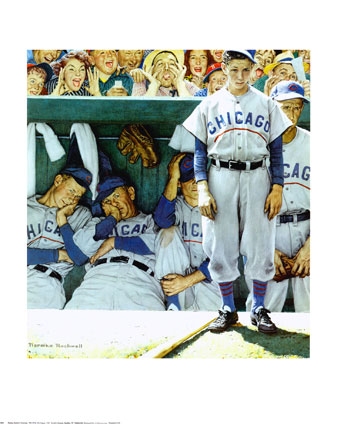
Being a liberal political junkie is sort of like being a Cubs fan. Every once in awhile, they manage to put together a winning team and make it into the post season, but Don Kessinger always always always drops a routine fly allowing the Mets to score three runs in the top of the ninth in game seven, if you know what I mean, and I think you do.
Well, somehow, the Cubs have made into the playoffs again, and the BIG GAME is on Tuesday. The fans are gripping the arms of their chairs waiting for the inevitable Steve Bartman to appear and fuck everything up. The suspense wears me out. I just want to go to bed and try not to think about it and wait until morning to find out what happened. But the suspense never ends. Even if John Kerry doesn’t throw over the first baseman’s head and we make it past the finals, we still have to play in the World Series. It’s too aggravating. I want to return to the comfort of ‘wait-till-next-year.’
But I can’t.
It’s like a car wreck — despite the repugnance of it all, I just can’t turn away. But that’s another metaphor. See what I mean? I can’t even face the thing directly. I need all these fucking metaphors just to discuss it. What hell.
Well, the Cubs have signed Lou Piniella as manager, and rumors are flying that A-Rod might also join the squad. In any event, Cubs General Manager, Jim Hendry has vowed to spend the necessary money to put together a winning team, so the future looks bright for the Cubs once again.
But for the Democrats, the future is now. But instead of playing to win, I fear they are playing to not lose, and that makes me sick with that familiar apprehension. It also makes me wonder why I even follow this sport. I mean, they’re just a bunch of whiny millionaires.
Friday, October 14, 2005
Temporary Insanity

Once again, the employment god has cast a critical eye in my direction. Without dwelling on the details, let’s just say that my most recent situation came to an acrimonious end. It wasn’t my fault — really. I didn’t mean to tell the boss his way of doing things was moronic; it just slipped out. In any event, my meager wages from that job left me little time with which to contemplate my next move. I had to act fast or I’d be spending the winter under a viaduct.
One of my previous swims in the treacherous waters of pre-employment dealt me an entanglement with a dangerous sea creature known as a temporary agency. The temporary agency is a creature with long, powerful tentacles with which it draws its prey into a deep, dark world of cubicles and 15-minute breaks and fast food lunches and unwanted friendships. The temp agency feeds primarily on desperation and aspiration, but will settle for a steady diet of petty recriminations. Its victims struggle eternally in a web of cute, inspirational banners and office birthday parties.
A favorite method of capture for the temp agency is to attach a tentacle to the victim and then just sort of forget about it. The would-be victim goes about its business unaware that it has a tentacle attached. In rare cases, the victim grows big and strong and the tentacle is unable to reel it in. The temp agency doesn’t care; it has many tentacles. But, more commonly, the victim goes about its business until some trouble arises and a struggle ensues. The struggle is an instantaneous signal to the temp agency, which quickly attaches more tentacles to both combatants. The scorned employer is suddenly in the market for fresh meat. The temp agency’s tentacles tighten. The unappreciated employee self-righteously but desperately seeks another source of income. The tentacles tighten.
Such was the case for me when I found myself — again — in the boiling and infested sea of hunger and overdue bills. The tentacle rescued me. It scooped me up and placed me gently on the warm beach of secure employment. It placed a refreshing drink in my hand, and, just as my lips were about to meet the straw, the tentacle jerked me violently into a deep miasma of pointless, demeaning servitude.
Some days are just unBEARable.
As I dressed myself for my first day of training, I noticed that my gut was even more difficult to tuck into my “good” pants than it had been at my previous job. Either I had been drinking more beer — and that can hardly be possible — or my metabolism is slowing with age and all that beer is growing more difficult to burn off. The previous night’s session was no consolation: I had to drink at least five beers just to find the courage to accept this dead-end position.
I arrived at my assignment at 8:30, but Kathleen Watson’s digital clock radio read 8:39. Kathleen Watson was the head of the company’s human resources department, which meant that she was the overseer of all the wage slaves. She didn’t look afraid to use the whip.
“May I help you?” she asked icily.
I quickly and timidly stated my business.
“Oh. Finally,” she said. Her short hair was red on the outside and black on the inside. Her tight dress revealed what was probably once a great body, but now it looked as though it had seen many miles of rough road, as they say. Her creased face and baritone voice betrayed years of smoking. I tried to imagine what brand of cigarettes she smoked. After a moment’s consideration, I concluded that she must smoke More’s — those long, dark brown, cigar-like coffin nails. She wore bright red rouge on her cheeks and crimson lip-gloss. Suddenly I pitied her.
“I’m sorry. Am I late?” I asked apologetically.
“You were supposed to be here at eight.”
“Oh. I was told 8:30,” I explained.
“Well, it’s eight thirty-nine,” she said sharply. Then she spirited away. I wasn’t sure if I should leave or stay. Had I missed the opportunity, such as it was? Suddenly, she returned with two pieces of paper.
“Sign here and here,” she commanded. I obeyed. “You can wait over there,” she said, gesturing crudely at a couple of chairs. I sat down and picked up a Newsweek that was resting on the end table. I flipped serendipitously to a story — a story, mind you, not an advertisement — about a $1.2 million special edition Mercedes Benz that will soon be available — sort of. The one pictured next to the article looked like something Johnny Quest would drive. It had a silverish aura around it. Mercedes, according to the article, plans to manufacture only 25 of the cars. It has a V-12 engine, gull wing doors, some kind of ceramic polymer body and an unfathomable top speed. In order to change a flat tire, the article said, owners must wait for a specially trained German mechanic to fly in from Mercedes headquarters in Bonn. Mercedes has already received 200 orders for the machine, which gets eight miles to the gallon.
Someone called my name. I looked up to find that a fat, blonde woman was, by all outward indications, extremely happy to see me.
“Hi!” she exclaimed. For a moment, I thought she recognized me from somewhere. I tried briefly to place her face in my resinated memory, but I quickly realized that I have met at least a million women just like her. Her manner of speaking turned everything into a one-word question.
“Firstthingwe’regonnado?” she began. “IstakeyerpitcherforyerIDbadge?”
“Okay,” I replied hesitantly.
“Okay!” she cheered. She shuffled hastily away, cradling a clipboard like a child on her ample hip. I inferred that I was supposed to follow her.
In a small room down a dark hall, someone had erected an enormous camera and tripod assembly. She nudged me into a chair and shoved my head against the wall. She then jerked my head to the side so that it lined up with a piece of tape on the wall.
“Okay!” she cheered again. She leapt behind the enormous howitzer of a camera and aimed a menacing flashbulb right at my face. A blast of pure white blinded me for several seconds.
“Okay! One more!” she exclaimed. The second shot, I figured, was meant to insure total blindness.
As I sightlessly groped my way, she led me through a maze of cubicles until, at last, we reached one occupied by another obese woman. This woman, who I could barely see, was going to be training me for the next few days. She, too, spoke in one-word questions.
“Himyname’sjenniferhowyadoin’?” she chirped. As my eyes recovered, I noticed a poster hanging on the wall of her cubicle. It was a photograph of a yawning grizzly bear. Along the bottom, in cheerful lettering, the caption read: “Some days are just unBEARable!”
“I’ll drink to that,” I thought.
After a while, with Jennifer yammering endlessly and me nodding in endless agreement, I became aware of several other posters decorating her cubicle. They had obviously been manufactured for fourth grade classrooms. One showed Charlie Brown and Peppermint Patty and the gang painting a big sign that read, “Everything goes better when we work together!” Another one had a photo of a gorilla that appeared to be smiling — wildlife is popular among cubicle dwellers — the caption read: “Smile! It’s the first thing people like about you!” Yet another poster showed a bald eagle in two views superimposed on one another. Its caption read: “Let your dreams take flight!”
Obviously, exclamation points are the only punctuation employed by inspirational poster manufacturers.
The company to which I had been assigned on this go-around ran some sort of money order scam. It involved risky, short-term investments and probably resided somewhere right on the edge of legality. The place was loaded with surveillance cameras and signs that read “Access Restricted.” Everyone — even temps — had to wear an identification badge and security card. The card and the badge were attached to a retractable spool that could be clipped to a strap or belt.
On the second morning of my assignment, I was accosted near the front door by a security-conscious prick. (They’re everywhere these days.)
“Have you got your badge?” he demanded in a passive-aggressive sort of way. Now at this particular point in the day, a beige cubicle festooned with childish regalia was just about the last place on Earth I wanted to be. I should have said, “Nope. I’m an interloper. Kick me out.” But, instead, as you already know, I said, simply, “Yep,” as I obediently extended my ID badge. The frustrated Gestapo asshole reluctantly let me pass.
The training for my pathetic assignment consisted of two phases. The first was to learn how to load and operate the electronic money order dispensers used by the company in its scam. Since the rest of the operation relied on economic mumbo-jumbo and loopholes, mastery of the dispensers — the only tangible ingredient in this recipe for deceit — was required by everyone. The dispensers came in four models, from old and crappy to new and crappy. I had to learn the rudiments of their operation so that, when convenience store workers called me with questions about their machine, I would be able to walk them through the solution, step by step.
The second phase of training entailed learning how to read a variety of computer screens between which I would eventually be flipping. The screens provided the viewer with essential information about the money order machine in question. The convenience store worker would call to report — often in broken English — a malfunction of some sort with his or her money order machine, and the operator — me — would use the information on the screens to identify the problem, work on a solution and record the events of the call.
Due to lack of interest, I was the only person who showed up for training. This, said Jennifer, meant that training would go “way faster.” As we concluded each step of what I considered a mind-numbingly slow process, Jennifer would squeal with delight: “My! Ican’tbelievehowfastwe’regoing!”
Midway through the pea soup fog of my first morning, the first obese woman returned with my access card and identification badge. The badge was still warm from having been run through an electric laminating machine. The picture on my badge betrayed the feeling of dread that had been — and was still — coursing through every fiber of my being. No mention was made of the second picture. No doubt it has found its way into my Permanent Record.
Break time. At last. The only positive aspect of this particular work environment is the religious devotion its inhabitants have toward breaks. This is undoubtedly the result of countless migraines, acts of vandalism, unearned sicknesses and other forms of productivity-reducing defiance from the wage slaves. I walked to the lunchroom as quickly as I could without attracting attention. I poured myself a large cup of bad office coffee in a futile effort to fortify myself against the insanity that surrounded me. Coffee was the only mind-altering chemical permissible in this land of NFL memorabilia and United Way fundraisers, so I partook heavily. I sat down and completed a crossword that someone else had tried to fill in using a yellow felt-tip. The lead story in that day’s paper told of a local doctor who had punched a woman in the face. The woman, according to the story, had cut in front of the doctor in traffic. Naturally, the public’s sympathy was with the woman; naturally, mine was with the doctor.
Upon my return from break, I detected a commotion of some sort wending its way slowly through the cubicles. If it continued on its present course, the commotion would eventually arrive at my desk. I would be forced to interact. It wouldn’t be so bad if they would just let you work in silent hatred, but there is always some “Rah! Rah! Sisboombah!” bullshit taking place that is obviously designed to convert the nonbelievers. It’s like a Christian summer camp five days a week.
As the commotion in question made its way relentlessly toward me, it became clear to my non-believing eyes that it consisted of four grown men dressed as old ladies.
“What the fuck is that?” I demanded. In panic, I pursed my lips. Did I say that or just think it?
“Oh. It’stheMoneyGrams,” explained Jennifer gleefully. MoneyGram, she said, was one of the product services offered by the company. The company, she said, invented a character called a “MoneyGram,” which was really just a money-dispensing old lady, to promote this product service. Every month, in an effort to raise money for United Way, some of the employees would take part in a goofy stunt of some sort. On this particular occasion, some of the employees offered to pay an unspecified amount of money to United Way if these clowns would dress up as “MoneyGrams.” The poor slobs had to choose between paying the unspecified sum or dressing up as old ladies, in which case the challenger would be compelled to make the payment. I was doubly horrified. For starters, I had no desire to stand there and take part in this foolishness, and, secondly, I feared that the longer I worked there, the greater the chances that I would be forced to participate. But, by that time of course, I will have been thoroughly converted. It was all I could do to keep from running away.
After four days of this nonsense, I concluded that sleeping under a viaduct wasn’t that bad after all. When I went to the temp office to turn in my time sheets, I told my supervisor that I could no longer tolerate this position and that I wanted another assignment. She looked at me with that look that people give you when you tell them that you hate something that they love — blueberry pie or For Whom the Bell Tolls, for instance.
It was unfathomable to her that, in this economy, someone would choose not to leap at the chance to become part of the Great American Workforce. To her, I was one of “them;” I was one of the people who “chose” to eat out of dumpsters and guzzle cheap wine. Nothing I could say would illuminate the vast regions of voluntary ignorance that occupied her soul.All I could do is take a deep breath and wonder silently if I had enough money for a beer.
 |
 |
 |
 |
 |
 |
 |
 |
 |
 |
 |
 |
 |
 |
 |
 |


