In your estimation, is the land reform issue at the root of the political crisis in Zimbabwe?
Indeed, land reform or the absence of a genuine pro-poor land redistribution policy is a major source of the socio-economic and political crisis in Zimbabwe. But it is inaccurate to trace everything to this single driving factor.
The most productive resources remain concentrated in the hands of a few (including the black elite). But the land issue alone cannot explain the depth, breath and long duration of this crisis. Other post-independence economic and social policy blunders plus the dictatorial degeneration of the ZANPU-PF regime must also be factored into this story.
How has the land reform issue been dealt with in South Africa?
In South Africa, land reform is law-abiding and modeled on the willing seller willing buyer template promoted by the World Bank. In other words, it is through the law and the market, the pillars of land reform entrenched in the post-apartheid Constitution, that 30% of white-owned land is to be transferred to blacks.
Fast-tracking land restitution with a tougher expropriation law is becoming increasingly popular among ANC politicians- especially those most likely to seize hold of parliamentary power after the 2009 national elections.
What risks exist for the regional economy as a result of the ongoing crisis in Zimbabwe?
This really depends on who one talks to and at what time. Among most investors, the mood is very gloomy, but they are eager to pour capital into Zimbabwe if there is greater stability.
South Africa’s poor record in attracting long-term fixed capital investment is often blamed on the crisis in Zimbabwe. But it is not easy to support this claim with hard evidence given the many other things happening in South Africa and other neighboring countries. Other resource based economies in the region (such as Angola and Botswana, for instance) have been attracting investors.
For the rural and urban poor, on the other hand, this is a different matter. The region appears to be unable to handle the sharp rise in out-migration from Zimbabwe. This factor, no doubt, has contributed to the mindless violent attacks on nationals from neighboring countries which have erupted mainly in South African slums.
Do you expect violence in Zimbabwe to worsen prior to the June 27 runoff?
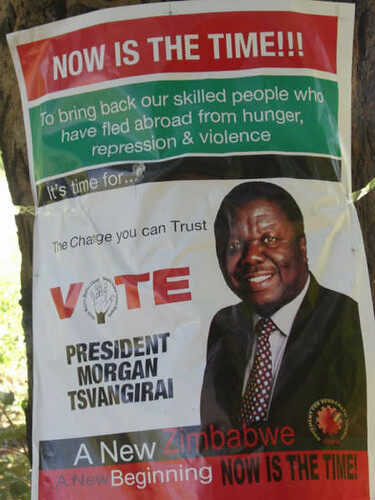
The entire state machine is now deployed to terrorize Zimbabweans. And the post-election humanitarian crimes and brutality of the regime go far beyond imprisoning the 2 vociferous leaders of the MDC,
Arthur Mutambara and
Morgan Tsvangirai.
The worst scenario as the country heads towards the run-off poll on June 27 is a massive intensification of this campaign of violence. In the best scenario, the run-off will take place in a volatile climate of fear, intimidation and the threat of destabilization.
Are the people of South Africa satisfied with the response of their government to what is happening across the border?
South African reactions to the crisis in Zimbabwe can best be described as mixed. Elements within the governing ANC have been speaking out against ZANU-PF, asking it to accept its defeat in the March elections.
This runs counter to the official ‘quiet diplomacy’ approach of
President Mbeki and leading state officials. In their view, Zimbabwe is an independent and sovereign state which needs to resolve its internal difficulties without external interference.
Civil society groups, including
COSATU which is the trade union federation allied to the ANC, have been demonstrating against the human rights record of the Zimbabwean government. Aside from this ‘indirect lobbying’, poorer South Africans have not expressed or articulated any organized public dissatisfaction towards the way government has handled the Zimbabwean situation so far.
Minority opposition parties in South Africa, like the
Democratic Alliance and
Independent Democrats, however, want the Mbeki cabinet to shift from its ‘quiet diplomacy’ stance to active support for ‘regime change’.
What should an MDC or a unity government do to address the dire economic conditions inside Zimbabwe?Let us assume that there is no rigging of the June 27 run-off and the MDC scores a landslide victory. What the MDC needs to tackle in this context, for a start, is to stop the economic meltdown of Zimbabwe, create a free space for civil society to engage in politics and implement a pro-poor redistributive project.
Large-scale capital investment is required to rebuild its physical and social (healthcare, education, etc) infrastructure. Private foreign capital inflows may not be enough to quickly address these needs, yet privatization is core to its economic platform.
To boost food security, it needs an integrated program to redistribute land and agricultural resources to poorer farmers. However, until now, the MDC appears to have woefully neglected drafting a clear proposal on how to resolve Zimbabwe’s complex land question.
photo by
babasteve