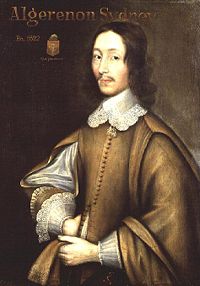
Political philosopher Algernon Sidney [1623-1683] was among the greatest influences on the Founders along with John Locke. Per Eli's recent request in our comments section, Sidney's view of "Classic Natural Right" [Plato, Aristotle, Cicero, etc.] as proposed here in Leo Strauss' Natural Right and History.
From Thomas G. West's foreward to Sidney's seminal Discourses Concerning Government [1680]:
"Prudence dictates that political constitutions are to some extent relative to the particular circumstances of a people. Rome became so corrupt that “the best men found it...impossible to restore liberty to the city.” But Sidney was not a relativist. The principles of government are eternally true; only their application varies with the times.
Sidney opposed hereditary monarchy not only because it denies liberty, but because it denies equal opportunity for merit. Unlike some other writers whose political theories were based upon man’s natural liberty, Sidney accepted the principle, taught by Plato and Aristotle, that the most virtuous ought to rule. “Detur digniori [let it be given to the worthier] is the voice of nature; all her most sacred laws are perverted, if this be not observed in the disposition of the governments of mankind.”
Sidney was even willing to admit, with Aristotle, the right of a godlike prince to rule without the consent of the governed. “When such a man is found, he is by nature a king.” But Sidney went on to deny, in Aristotle’s name, that any such being could be found among imperfect human beings. Thus the apparently aristocratic Aristotle turns out to be a teacher of republicanism.
From this argument we may better understand why Thomas Jefferson said the Declaration of Independence was based on “the elementary books of public right, as Aristotle, Cicero, Locke, Sidney, &c.” and why the monarchical philosopher Thomas Hobbes complained that the ancient Greek and Roman authors taught Englishmen that democracy was the best form of government."


0 Comments:
Post a Comment