Thursday, October 6, 2011

Uncertainty is the Strength of Occupy Wall Street

Now seems as good a time as any to start reading The Black Swan: The Impact of the Highly Improbable by Nassim Nicholas Taleb. He writes in a passage on negative empiricism that "you know what is wrong with a lot more confidence than you know what is right." This statement resonates with me as the ethical backbone of the "occupation" style protests that have swept the world this year.

What do they want? is the common refrain in the media. It's OK that nobody knows yet. In fact, it would be sheer arrogance to assume that a small cadre has all the answers. The point is that when even in rich societies like the United States tens of millions of people are living in poverty, new processes are needed for people to debate the actions, rules, and directions of our societies.

The protesters in lower Manhattan have opted for a process of collaborative consensus. We shouldn't expect them all to be policy wonks (though even a Nobel laureate economist has stopped by). They are instead what Paul Hawken calls our social immune system. Here is their first statement:

STATEMENT OF THE NYC GENERAL ASSEMBLY

As we gather together in solidarity to express a feeling of mass injustice, we must not lose sight of what brought us together. We write so that all people who feel wronged by the corporate forces of the world can know that we are your allies.

As one people, united, we acknowledge the reality: that the future of the human race requires the cooperation of its members; that our system must protect our rights, and upon corruption of that system, it is up to the individuals to protect their own rights, and those of their neighbors; that a democratic government derives its just power from the people, but corporations do not seek consent to extract wealth from the people and the Earth; and that no true democracy is attainable when the process is determined by economic power. We come to you at a time when corporations, which place profit over people, self-interest over justice, and oppression over equality, run our governments. We have peaceably assembled here, as is our right, to let these facts be known.

They have taken our houses through an illegal foreclosure process, despite not having the original mortgage.

They have taken bailouts from taxpayers with impunity, and continue to give Executives exorbitant bonuses.

They have perpetuated inequality and discrimination in the workplace based on age, the color of one's skin, sex, gender identity and sexual orientation.

They have poisoned the food supply through negligence, and undermined the farming system through monopolization.

They have profited off of the torture, confinement, and cruel treatment of countless animals, and actively hide these practices.

They have continuously sought to strip employees of the right to negotiate for better pay and safer working conditions.

They have held students hostage with tens of thousands of dollars of debt on education, which is itself a human right.

They have consistently outsourced labor and used that outsourcing as leverage to cut workers' healthcare and pay.

They have influenced the courts to achieve the same rights as people, with none of the culpability or responsibility.

They have spent millions of dollars on legal teams that look for ways to get them out of contracts in regards to health insurance.

They have sold our privacy as a commodity.

They have used the military and police force to prevent freedom of the press.

They have deliberately declined to recall faulty products endangering lives in pursuit of profit.

They determine economic policy, despite the catastrophic failures their policies have produced and continue to produce.

They have donated large sums of money to politicians, who are responsible for regulating them.

They continue to block alternate forms of energy to keep us dependent on oil.

They continue to block generic forms of medicine that could save people's lives or provide relief in order to protect investments that have already turned a substantial profit.

They have purposely covered up oil spills, accidents, faulty bookkeeping, and inactive ingredients in pursuit of profit.

They purposefully keep people misinformed and fearful through their control of the media.

They have accepted private contracts to murder prisoners even when presented with serious doubts about their guilt.

They have perpetuated colonialism at home and abroad.

They have participated in the torture and murder of innocent civilians overseas.

They continue to create weapons of mass destruction in order to receive government contracts.*

To the people of the world,

We, the New York City General Assembly occupying Wall Street in Liberty Square, urge you to assert your power.

Exercise your right to peaceably assemble; occupy public space; create a process to address the problems we face, and generate solutions accessible to everyone.

To all communities that take action and form groups in the spirit of direct democracy, we offer support, documentation, and all of the resources at our disposal.

Join us and make your voices heard!

*These grievances are not all-inclusive.

[PHOTO CREDIT: David Shankbone (CC).]

Wednesday, August 31, 2011

Plosser thinks there is no jobs problem


So while we wait for the jobs plan that the president will announce later this week, the Fed published the minutes of the Federal Open Market Committee's (FOMC) meeting.  Three members, including Real Business Cycle (RBC) guru Charles Plosser, voted against maintaing interest rates close to zero until 2013. The three that voted against are afraid about core inflation, and signaling that rates will not increase if inflation accelerates.   Also, somebody believes that a slight increase in core inflation with the slightly lower unemployment (even though the lower unemployment is related to participation rates) implies that potential output is lower.  Not kidding.  Precise words in the minutes are:


"A couple of others, however, suggested that the juxtaposition of higher core inflation and somewhat lower unemployment could imply that the level of potential output was lower than had been thought."

The economy grew 0.7% in the first six months of the year, and we are still below the previous peak, but we're close to potential output?! My guess is that "the couple of others" includes Plosser.  In other words, this guy thinks that around 9 percent unemployment is close to the natural rate.  Nothing like believing that anything is full employment to convince yourself that markets actually produce optimal outcomes.

Sunday, August 14, 2011

I know, I know, I should be grading (or working on my diss), but c'mon Mr. President, 400K jobs a month!


A 1932 Low cartoon via Luke Ashworth via Worthwhile Canadian Initiative.


I promise I am grading, but Ken Rogoff was just sounding like a total idiot (sorry, nothing pejorative intended for those who truly deserve our support) arguing (need I even add badly?) with Paul Krugman on Fareed Zakaria's GPS. So I can't help myself.


We do need to do whatever possible to shake this President out of his torpor. Here is the beginning of a campaign I just posted on Economist's View, and will be posting wherever there are smart readers. Quoting


"C'mon Mr. President!!! 400,000 jobs a month. Private, public, we need them all. If Plouffe and Daley disagree, tell them to get with the program.


Listen to your economists, present and former. Romer in particular is showing the right brand of spunk ... watch her Bill Maher appearance... and has the economics right. Sperling has both the politics and the economics right. 400,000 pragmatic jobs a month. Hell or high water. You're the President. C'mon.

Here's just one of many links to Romer (this one from HuffPo):

Send the kids out of the room."

I am actually beginning to like Christy Romer in spite of past peccadilloes.


Ok, back to grading, but not before I pose a related question: How is that austerity thing going after the riots this week Mr. Prime Minister Cameron?


Saturday, July 23, 2011

The Colombia FTA: Only Corporations Win


Trade has been a contentious issue in U.S. politics for a very long while. In recent times, free trade agreements have been promoted as essential by the cheerleaders of globalization, and as a threat to good jobs with decent wages and benefits by those who are skeptical about the advantages of the global economy. President Obama, a man of broad views, seems to represent both opinions. On February 12, 2008, candidate Obama made the following argument on this issue:


“It’s a game where trade deals like NAFTA ship jobs overseas and force parents to compete with their teenagers to work for minimum wage at Wal-Mart. That’s what happens when the American worker doesn’t have a voice at the negotiating table, when leaders change their positions on trade with the politics of the moment, and that’s why we need a President who will listen to Main Street—not just Wall Street; a President who will stand with workers not just when it’s easy, but when it’s hard.”

The previous year, Senator Obama had opposed trade deals with Colombia, Panama, and South Korea, while favoring one with Peru. Facing several critics, even before he won the nomination, Obama clarified that he did not intend to unilaterally revise NAFTA, but would be favorable to having a dialogue about the costs of free trade agreements (FTAs). Once in office, however, Obama seems to have made a 180-degree turn.


Read the rest here.

Thursday, December 17, 2009

Plan for a Renewable Future

Policy Innovations contributor Roy Morrison weighs in on alternative global warming solutions and related policies to finance them. He calls for a 20-year plan to transition to renewable resources:

The popular wisdom is that a global emissions reduction agreement through cap and trade or taxation is humanity's last best hope before the consequences of melting ice and methane hydrates make irrelevant further human efforts to stop global warming. If that's true, we are in grave danger indeed. We should instead focus on a workable global investment and jobs plan to build the global renewable resource infrastructure that can sustain global prosperity while slashing global greenhouse gas emissions.

The plan will draw upon existing and emergent renewable energy technologies. These technologies range from the now-familiar wind turbines, photovoltaic solar arrays, hydropower dams, and geothermal plants, to new solar concentrators and medium-temperature geothermal systems running organic Rankine cycle generators. These will be combined with electric and renewable-fueled hybrid vehicles using their lithium batteries for energy storage. Renewable systems are characterized by rapidly improving energy conversion efficiency and declining cost.

We should understand that the problem is not that we do not have sufficient renewable resources. This is a plan that will create millions and millions of new jobs and global markets for our products and at the same time free us from the fossil fuel curse and its economic, ecological, and security threats.

The plan for a renewable future is based not on imposing taxes on the unwilling or forcing everyone to eat celery. It's time to stop focusing our efforts on raising costs for polluters who are politically powerful and will fight us every step of the way. We can do without the higher taxes or complex cap and trade schemes that will further enrich Wall Street sharks and may not even work.

It's absolutely clear that markets with sharply fluctuating asset prices, whether for carbon credits or Renewable Energy Credits (RECs), do not provide sufficiently stable long-term cash flows to convince bankers and investors to risk trillions of dollars financing a sustainable future.

For example, I'm working on building solar farms in New Jersey. New Jersey, admirably, sets high regulatory alternative compliance payments (ACP) for energy suppliers that do not purchase solar RECs (SRECs) from solar developers. But since the actual price for those SRECs is determined by a bid-and-ask market with fluctuating prices, there is no working futures market for buying and selling large quantities of SRECs. Why stock up on SRECs now when prices could plunge, as they have for RECs around the country and for carbon in Europe?

Without a long-term SREC contract in hand, financiers will not invest hundreds of millions of dollars in solar farms. We are scrambling to negotiate deeply discounted long-term deals with electricity suppliers and designing our own innovative financial structures to get the financing to build our solar farms.

What works much better is the feed-in-tariff (FIT) used by Germany and now by Ontario. The Ontario Power Authority offers 20-year fixed price contracts, at different price levels, for various renewables, with the goal of ultimately eliminating the province's reliance on coal. You can take an approved design and a 20-year OPA contract to the bank.

If it's true that renewable resources can do the job, then why not put America on the path to its own 20-year plan? As renewable resources and a continental-scale renewable smart grid are phased in, fossil fuel resources will be phased out gradually. The oil and coal can be left in the ground, or sometimes used for chemical feedstock in accord with an industrial ecology of zero waste and zero pollution.

As we increase renewable resource use by a small percentage each year, natural gas can serve as the transition fuel. We don't even need to build the next generation of coal and nuclear plants and gas-guzzling automobiles. If it's politically necessary, we can pay the coal companies for mineral rights, much as we have paid farmers not to plant corn. And, of course, we could stretch the time frame out for 40 years to 2050. But why do that? The risks are too high to drag our feet, while the benefits of implementing a 20-year plan are enormous.

In 20 years, by 2030, fossil fuel power can be an artifact of a bygone era. Gasoline-powered engines would become a once-a-year treat at the county fair demolition derby. The daily news would be not about military deployments, but about surprising new trends in building an ecological civilization.

There's no reason to wait. Renewable resource construction is already moving ahead. It just needs a little more systematic push. Mechanisms we can rely on include:

Feed-in-Tariffs: We set goals for phasing in renewables and phasing out fossil fuels and nukes. We offer long-term contracts at prices sufficient to support investment given current capital costs and energy market prices. Most renewables have zero fuel cost, but high capital costs. Periodically, the price level of new FIT contracts are adjusted to keep up with changes in capital costs and market income as more renewables are phased in and the need for subsidies decreases. The FIT should be applicable to storage and efficiency projects as well as generation.

Continental-Scale Renewable Smart Grids: We transform the current regional power grid system into one capable of operating efficiently on a continental scale using High Voltage Direct Current (HVDC) power lines and smart controls. Such continental systems will be designed to optimize the balance between distributed local resources and system resources. Developing efficient and cheap local devices such as fuel cells, heat pumps, photovoltaics, batteries, flywheels, and capacitors means a potential major reduction in large scale "system" generation and storage resources needed to move large amounts of power over long distances.

Self-Equilibrating Systems: The system can be designed to operate in a substantially self-equilibrating and highly secure manner using cybernetic feedback loops. By equipping end-use devices and distributed generation with the ability to sense and respond to fluctuations in local voltage and frequency, the system can be substantially self-controlling, capable of operating in a regional fashion in the event of system disruption, and largely immune from cyber attack from malware and viruses since there will be few control signals to sabotage such as the current Automatic Generation Control (AGC) signals.

Clean Development: Development aid must be provided in sufficient quantities for poor and developing nations to make the transition. In countries without a national power grid, regional renewable resources with local storage and smart control can do the job. The approach must be global or it will fail. Global problems will require global solutions and cannot be accomplished upon the backs of the poor for the benefit of the rich.

This is a plan with winners and few losers. We build massive new non-polluting industries, and create millions of good-paying high-technology manufacturing, installation, computer control, and service jobs. In addition to transforming the economy, we free ourselves from the oil curse, the resource wars, and balance of payments nightmares. Cash will flow in from our customers instead of out to the sheikhs and oil barons. And we will lessen the threat from nations that wish to enrich uranium for "peaceful" purposes under the Non-Proliferation Treaty (NPT).

Today we face resolute opposition to anything more than marginal changes in emissions from such political and economic heavyweights as the global coal, oil, auto, and electric industries, and from major energy exporting and importing nations such as OPEC, Russia, China, and even the United States.

It's time to stop trying to plow a granite field. We can instead focus our efforts on an investment and job strategy that will build the renewable infrastructure and the powerful new industries that will be the basis not only for the prevention of climate catastrophe, but also for the development of prosperous and sustainable ecological future.

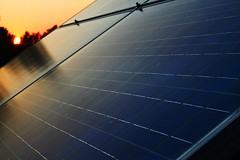
[PHOTO CREDIT: Photovoltaik, by Bernd Sieker (CC).]