Wednesday, June 15, 2011

WindMade Public Comment Period Opens

I recently biked 300 miles over five days from New York City to Washington, D.C. as part of the Climate Ride, a semiannual charity event that raises money for bicycle and environmental organizations. My primary motivation in riding all the way to Capitol Hill (with 120 bright people from the sustainability sector) was the opportunity to meet with legislators to discuss climate change, clean energy, and transportation policy.

Vested interests in the coal, oil, and gas industry would likely characterize such a voyage as quixotic, and they would be correct in one sense: I saw some windmills along the way, each one representing a different phase in America's energy history—Past, Future, and Present.

Windmill 1: The first type of windmill I encountered was actually a windpump. The old beast was motionless and looked something like this:


Alexis Madrigal of The Atlantic has a great chapter in his book, Powering the Dream: The History and Promise of Green Technology, on how innovative businesses and American DIY culture combined to dot the Great Plains with these pumps, making settlement and agriculture possible in arid regions. The technology is still incredibly useful, but it symbolizes the Past.

Windmill 2: The second creature I spied was perched on an Amish rooftop, spinning madly, and looked a bit like this sleek species:


As Kevin Kelly notes in his tome What Technology Wants, the Amish are not adverse to technology as long as it doesn't distort their cultural ethics. They even have social procedures for testing and evaluating new devices, and abandoning them if they are deemed inappropriate. Small modern wind turbines thus symbolize a possible energy Future where innovation is encouraged.

Windmill 3: Finally, I encountered this monster in Morgantown, PA:


I didn't go rooting through the restaurant's trash to find its electricity bill, but the probability is high that this decorative windmill is powered mostly by dirty coal, as Pennsylvania represents 5.3 percent of America's annual coal consumption. This windmill symbolizes the profligate Present.

I bring this up because a consortium of partners has just launched an innovative initiative to label organizations and products as "WindMade." It is a new chapter in what my colleague Michael Conroy calls the certification revolution, one of the primary forces driving branded companies to improve their environmental, social, and governance indicators. It also builds on the legacy of other "trustmarks" such as Fair Trade, Organic, Forest Stewardship, and Marine Stewardship.

In order to qualify for WindMade certification an organization will have to prove that it is getting at least 25 percent of its electricity from wind power. This can be accomplished via on-site turbines, long-term power purchase agreements, and renewable energy credits. The WindMade standard will roll out later this year, starting with certification of whole organizations and specific locations such as factories, while phase two will expand the process to include product certification.

In an innovative crowd-sourcing move, WindMade has opened up its technical standard for a 60-day public comment period to solicit feedback and advice on how it can be improved.

The primary sponsor of this project is the Danish wind company Vestas, the world's leading turbine manufacturer. Vestas has agreed to fund WindMade as an independent nonprofit for its first three years, and going forward support is expected from all partners as well as the participating companies. When asked at a press briefing whether compliance costs would discourage adoption, Vestas representative Bragi Fjalldal indicated that the expense would be "negligible," especially for carbon-conscious companies that are already monitoring emissions.

Bloomberg is the data partner in this endeavor, providing market research, and Curtis Ravenel of their sustainability group estimated that some 100 companies would already qualify at the 25 percent level.

Clearly Vestas has a business interest in promoting wind power through a labeling system, but they also recognize that wind will never provide all of the world's energy needs. For this reason an alternate WindMade label will be available to companies that want to express the mix of energy they receive from wind, hydro, solar, and geothermal sources.

Another key stakeholder and participant in the WindMade process is WWF. According to Stephan Singer of their global energy policy division, climate change is the single gravest threat to species worldwide, which is why WWF has made the case that it is possible and necessary to achieve 100 percent renewable energy by 2050.

Another positive aspect of the WindMade project is that it intends to aid renewable energy deployment in the developing world. The exact details have yet to be determined, but Angelika Pullen of the Global Wind Energy Council said the following:

WindMade is a global initiative and will reach out to companies in other significant markets such as India, China, and Brazil in the public consultation process to determine how emerging markets and developing countries can best be included in the program. Overall, WindMade strives to make an impact beyond countries where wind energy is well established. It is our intention to raise funds to catalyze wind power projects in countries with less developed renewable energy infrastructure. This is a longer-term goal, however, so the details of how this will be operationalized are still under development.

Complaints about wind being an intermittent power source always strike me as odd, as if that's somehow a fundamentally worse problem than global warming or gyrations in the oil market. The greatest inconsistency I see has been in U.S. policy, which periodically allows wind investment incentives to lapse.

Whether climate change is to blame or not, the world is getting windier, and perhaps this will accelerate construction of offshore installations, which should be competitive with natural gas within the decade. Solar, too, is approaching or has reached grid parity in the sunniest locations.

With its potential to incentivize the growth of renewable energy—which is far from certain at this early stage, given the somewhat "mythical" nature of the ethical consumer—the WindMade label is an innovation that deserves the old "Amish" test run, and early adopters will likely reap a reputational benefit. The success of the program depends upon a strong and transparent technical standard immune from greenwash, which is what makes the public comment period so important. If you have your two cents, now is the time to deposit them.

Solar Policy Innovation in New York


The New York solar industry could soon get a big boost if the state legislature passes the Solar Industry Development and Jobs Act (they must be very excited about it, as the bill is typed in ALL CAPS). The video above explains the basic financing and Solar Renewable Energy Credit mechanism quite clearly.

The bill's goal is 5 GW of solar capacity by 2025, with participation from residential, commercial, and utility producers. The incentives and requirements would ramp up and be adjusted over the years to match a growing market and falling costs. Advocates predict that the bill will add some 22,000 new jobs and $20 billion of economic activity to the state, with the primary benefits being cleaner power, long-term reduction of peak power costs, grid reliability, and local generation to supplant the importation of fossil fuels.

This bill is a step in the right direction, but it's hard not to scratch one's head at the lack of ambition here. The target of 2.5 percent by 2025 looks paltry when compared to peer nations like Germany, which installed 7 GW in 2010 alone due to its feed-in tariff system, and that was a slow year! Energy and environment writer David Roberts notes that "German electrical ratepayers fund the program through a small fee that amounts to about 15 percent of their electrical bills," whereas one of the selling points of the New York bill is that it will add only $0.39
to the average residential electric bill. You get what you pay for.

Wednesday, July 14, 2010

A Renewable Super-Grid for Europe?

I encourage you to read this interesting interview with German energy analyst Gregor Czisch on the potential for a cost-neutral renewable super-grid linking Europe and North Africa. I've selected a few key quotes here highlighting the policy and geopolitical concerns.

GEOPOLITICS / ENERGY SECURITY

The gas pipelines currently in use act exactly like a super-grid, transporting gas from Sahara and from Siberia to Europe. There is no conceptual difference from transmitting electricity instead of gas.
...
The scenario with renewable electricity would be instead much more secure, because the sources can be diversified, with less dependency from single countries.
If we look at the recent Copenhagen debates: instead of developing new ideas, they are still discussing about the trading of CO2 emissions, carbon limits, carbon-taxes and other old-style proposals which hardly are effective because they are too much based on the unrealistic believe [sic] in the positive market forces and neglect the inelastic behavior of the consumers in the case of energy consumption.

POLICY HARMONIZATION
We further need a harmonized regulation to support the financing of these projects, for example a common European feed-in tariff able to cover the cost for production and transmission of the electricity.

BENEFITS FOR NORTH AFRICA
To import 10% of its electricity demand from wind energy in Morocco, Europe would have to invest about 3% of its GDP in wind generators in Morocco. This corresponds to roughly 200% of the Moroccan GDP. Such a decision would boost the local economy, creating jobs, local competences and industries.
It would be a clear sign towards a systematical change in the way we live together, because it would not be a fragmented intervention or a temporary help for a developing country, but a sustainable investment in order to serve for a mutual interest in the long term.

Thursday, December 17, 2009

Plan for a Renewable Future

Policy Innovations contributor Roy Morrison weighs in on alternative global warming solutions and related policies to finance them. He calls for a 20-year plan to transition to renewable resources:

The popular wisdom is that a global emissions reduction agreement through cap and trade or taxation is humanity's last best hope before the consequences of melting ice and methane hydrates make irrelevant further human efforts to stop global warming. If that's true, we are in grave danger indeed. We should instead focus on a workable global investment and jobs plan to build the global renewable resource infrastructure that can sustain global prosperity while slashing global greenhouse gas emissions.

The plan will draw upon existing and emergent renewable energy technologies. These technologies range from the now-familiar wind turbines, photovoltaic solar arrays, hydropower dams, and geothermal plants, to new solar concentrators and medium-temperature geothermal systems running organic Rankine cycle generators. These will be combined with electric and renewable-fueled hybrid vehicles using their lithium batteries for energy storage. Renewable systems are characterized by rapidly improving energy conversion efficiency and declining cost.

We should understand that the problem is not that we do not have sufficient renewable resources. This is a plan that will create millions and millions of new jobs and global markets for our products and at the same time free us from the fossil fuel curse and its economic, ecological, and security threats.

The plan for a renewable future is based not on imposing taxes on the unwilling or forcing everyone to eat celery. It's time to stop focusing our efforts on raising costs for polluters who are politically powerful and will fight us every step of the way. We can do without the higher taxes or complex cap and trade schemes that will further enrich Wall Street sharks and may not even work.

It's absolutely clear that markets with sharply fluctuating asset prices, whether for carbon credits or Renewable Energy Credits (RECs), do not provide sufficiently stable long-term cash flows to convince bankers and investors to risk trillions of dollars financing a sustainable future.

For example, I'm working on building solar farms in New Jersey. New Jersey, admirably, sets high regulatory alternative compliance payments (ACP) for energy suppliers that do not purchase solar RECs (SRECs) from solar developers. But since the actual price for those SRECs is determined by a bid-and-ask market with fluctuating prices, there is no working futures market for buying and selling large quantities of SRECs. Why stock up on SRECs now when prices could plunge, as they have for RECs around the country and for carbon in Europe?

Without a long-term SREC contract in hand, financiers will not invest hundreds of millions of dollars in solar farms. We are scrambling to negotiate deeply discounted long-term deals with electricity suppliers and designing our own innovative financial structures to get the financing to build our solar farms.

What works much better is the feed-in-tariff (FIT) used by Germany and now by Ontario. The Ontario Power Authority offers 20-year fixed price contracts, at different price levels, for various renewables, with the goal of ultimately eliminating the province's reliance on coal. You can take an approved design and a 20-year OPA contract to the bank.

If it's true that renewable resources can do the job, then why not put America on the path to its own 20-year plan? As renewable resources and a continental-scale renewable smart grid are phased in, fossil fuel resources will be phased out gradually. The oil and coal can be left in the ground, or sometimes used for chemical feedstock in accord with an industrial ecology of zero waste and zero pollution.

As we increase renewable resource use by a small percentage each year, natural gas can serve as the transition fuel. We don't even need to build the next generation of coal and nuclear plants and gas-guzzling automobiles. If it's politically necessary, we can pay the coal companies for mineral rights, much as we have paid farmers not to plant corn. And, of course, we could stretch the time frame out for 40 years to 2050. But why do that? The risks are too high to drag our feet, while the benefits of implementing a 20-year plan are enormous.

In 20 years, by 2030, fossil fuel power can be an artifact of a bygone era. Gasoline-powered engines would become a once-a-year treat at the county fair demolition derby. The daily news would be not about military deployments, but about surprising new trends in building an ecological civilization.

There's no reason to wait. Renewable resource construction is already moving ahead. It just needs a little more systematic push. Mechanisms we can rely on include:

Feed-in-Tariffs: We set goals for phasing in renewables and phasing out fossil fuels and nukes. We offer long-term contracts at prices sufficient to support investment given current capital costs and energy market prices. Most renewables have zero fuel cost, but high capital costs. Periodically, the price level of new FIT contracts are adjusted to keep up with changes in capital costs and market income as more renewables are phased in and the need for subsidies decreases. The FIT should be applicable to storage and efficiency projects as well as generation.

Continental-Scale Renewable Smart Grids: We transform the current regional power grid system into one capable of operating efficiently on a continental scale using High Voltage Direct Current (HVDC) power lines and smart controls. Such continental systems will be designed to optimize the balance between distributed local resources and system resources. Developing efficient and cheap local devices such as fuel cells, heat pumps, photovoltaics, batteries, flywheels, and capacitors means a potential major reduction in large scale "system" generation and storage resources needed to move large amounts of power over long distances.

Self-Equilibrating Systems: The system can be designed to operate in a substantially self-equilibrating and highly secure manner using cybernetic feedback loops. By equipping end-use devices and distributed generation with the ability to sense and respond to fluctuations in local voltage and frequency, the system can be substantially self-controlling, capable of operating in a regional fashion in the event of system disruption, and largely immune from cyber attack from malware and viruses since there will be few control signals to sabotage such as the current Automatic Generation Control (AGC) signals.

Clean Development: Development aid must be provided in sufficient quantities for poor and developing nations to make the transition. In countries without a national power grid, regional renewable resources with local storage and smart control can do the job. The approach must be global or it will fail. Global problems will require global solutions and cannot be accomplished upon the backs of the poor for the benefit of the rich.

This is a plan with winners and few losers. We build massive new non-polluting industries, and create millions of good-paying high-technology manufacturing, installation, computer control, and service jobs. In addition to transforming the economy, we free ourselves from the oil curse, the resource wars, and balance of payments nightmares. Cash will flow in from our customers instead of out to the sheikhs and oil barons. And we will lessen the threat from nations that wish to enrich uranium for "peaceful" purposes under the Non-Proliferation Treaty (NPT).

Today we face resolute opposition to anything more than marginal changes in emissions from such political and economic heavyweights as the global coal, oil, auto, and electric industries, and from major energy exporting and importing nations such as OPEC, Russia, China, and even the United States.

It's time to stop trying to plow a granite field. We can instead focus our efforts on an investment and job strategy that will build the renewable infrastructure and the powerful new industries that will be the basis not only for the prevention of climate catastrophe, but also for the development of prosperous and sustainable ecological future.

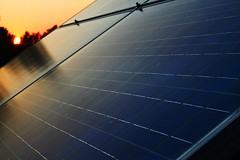
[PHOTO CREDIT: Photovoltaik, by Bernd Sieker (CC).]