Monday, January 23, 2012

A Conversation with Thomas Pogge

Last week, philosopher Thomas Pogge spoke at Carnegie Council. Our intern Sarah Aston summarizes his talk below:

Today’s international and economic system is founded on the principle of “profit maximization at any cost” and our challenge is to change this attitude argues Thomas Pogge of Yale University. Talking with Carnegie Council as part of the Ethics Matters series, Pogge reflected on his education under the guidance of political philosopher and advocate of universal justice John Rawls, and how seemingly abstract theories of justice can, and should be, applied to areas of international and social politics.

Pogge is known for his bold comparisons of today’s population in the developed world with the German population of 1930s Nazi Germany. Like the latter, we are, according to Pogge, part of a huge organism that allows for terrible atrocities to happen to our fellow mankind. Statistics show that one-third of all deaths today are premature due to poverty and yet we do not actively seek any solution to this problem in our system.

Drawing on this comparison, Pogge explained that he was compelled to develop Rawls’s theory of justice and practically apply it to areas of society. Rawls argues that there are two principles of justice that must be met within society and that all rational human beings would agree to these principles under a “veil of ignorance” in which they are unaware of their position in society. The first principle of Rawls’s theory is “First: each person is to have an equal right to the most extensive basic liberty compatible with a similar liberty for others” and this is where Pogge develops on Rawls’s work.

While Rawls argued that it was up to economists and politicians to satisfy this principle, Pogge argues that there must be clear instructions and guidance in order to change the system. His work with the Health Impact Fund is an example. Talking to Carnegie Council, Pogge explained that during research into the pharmaceutical industry he saw that the industry was driven by profit margins and competitive pricing rather than aiding those in need of the drugs. Pogge’s proposal to change the incentive system with a government - sponsored scheme of rewarding those companies that provide drugs to the most people with the highest impact and the lowest prices is a way of providing guidance on how to satisfy Rawls’s first principle of justice.

Pogge has chosen to focus on the pharmaceutical industry, but he told the Council that his work could be applied to all areas of the international system and that the system itself needed to address its system of incentives. When asked if he was optimistic about the future of the system he responded by saying we needed to design an economic system that meets the basic requirements of everyone and the way to do that is through education which will take a long time to filter through. The crisis we face today, however, offers an opportunity to reevaluate and re-structure our system.

- Sarah Aston

Tuesday, January 5, 2010

The People's Choice: Carnegie Council Top Ten 2009

2009 was a hard year on many fronts and this feeling was reflected in the Carnegie Council audience favorites. Concerns include making sense of the financial crisis; predicting future risks; and coming up with new strategies for the 21st century.

No. 7 on the list, "Top Risks and Ethical Decisions, 2009," was so popular that on January 13 a similar panel will predict their "Top Risks" for 2010 (with live webcast).

1. The Ascent of Money: A Financial History of the World
Niall Ferguson, Harvard University (video, audio, transcript)
The economies of China and America are so entwined that neither can afford to let the other fail.

2. The Next 100 Years: A Forecast for the 21st Century
George Friedman, Strategic Forecasting, Inc. (video, audio, transcript)
Which nations will be the winners and losers? These predictions may surprise you.

3. Sex Trafficking: Inside the Business of Modern Slavery
Siddharth Kara, Free the Slaves (video, audio, transcript)
The biggest illegal business after drugs, sex slaves generated profits of $35.7 billion in 2007.

4. On Promoting Democracy
Michael Walzer, Institute for Advanced Study (article)
States are not the only, or even the most important, agents of regime change.

5. Dead Aid: Why Aid Is Not Working and How There Is a Better Way for Africa
Dambisa Moyo, Economic specialist, Sub-Saharan Africa (video, audio, transcript)
Decades of international aid have only made things worse in Africa.

6. The Balance between Risk and Return Is Everybody's Business
Ann Rutledge, R&R Consulting (article)
Risk has shifted from corporations to individuals, and many ordinary Americans got burned.

7. Top Risks and Ethical Decisions, 2009
Ian Bremmer, Eurasia Group; Art Kleiner, Booz & Company; Michele Wucker, World Policy Institute; Thomas Stewart, Booz & Company (video, audio, transcript)
This expert panel predicts risks for what they agree will be a very tough year.

8. The Crisis of Islamic Civilization
Ali A. Allawi, former Iraq government official (video, audio, transcript)
What caused the decline of Islamic civilization and how can it be revived?

9. The Crisis of American Foreign Policy: Wilsonianism in the Twenty-First Century
Anne-Marie Slaughter, U.S. State Department (video, audio, transcript)
Who's right, the neocons or the liberal internationalists?

10. Justice: What's the Right Thing to Do?
Michael Sandel, Harvard University (video, audio, transcript)
A lively debate with the audience on what we owe to society.

Saturday, October 31, 2009

Stimulus, Justice, and Business in Greening the Developing World

I attended a business leaders luncheon last week organized by the United Nations Association around the idea of Greening the Developing World: Tech's Leading Role (Siemens and TIME co-sponsored). Among the themes one stood out: "Experiment on us!" This came from Minister Modest Mero of Tanzania. He indicated that Africa is an investment opportunity where clean energy pilot projects can take root because they don't have to fight the inertia of creative destruction common in rich countries.

But what is the policy and political landscape for greening development? Robert Orr, the Assistant Secretary-General for Strategic Planning and Policy Coordination, explained the relevance and success of the Clean Development Mechanism in this area. About half of new energy demand and development will be in poorer countries, he said, where 2 billion people live without modern energy access or technology. About one-third of CDM projects to date have involved technology dissemination to these countries.

Orr also made the point that it might be more useful to speak generally of "technology dissemination" instead of "technology transfer." He described the latter as too much of a 1960s–70s term. Recasting the process in this light would help account for co-development, PPPs, and other projects. (While I understand his pragmatic bent here, it does seem to gloss over the justice questions at stake in climate change.)

The CDM for all its faults [PDF] is not an insignificant pool of resources, and lessons have been learned from early implementation efforts. In 2006 some $25 billion was dedicated to projects in the CDM pipeline, $5.7 billion of which went to renewable energy and energy efficiency. But it should have come as no surprise for the UN to learn that money has flowed to the biggest, most profitable projects. As Orr acknowledged, about 80 percent of the projects have occurred in just five countries: Brazil, India, China, Mexico, and the Republic of Korea. Forty-nine other countries account for only 1.5 percent of CDM projects, showing a great need for equity and capacity-building. Orr explained that the UN role should be to help harness the power of the market in a formula that ensures full participation for access to energy.

On the topic of climate ethics, Ambassador Hardeep Singh Puri of India was asked to explain why the West should help countries like India that are its industrial competitors. He answered that you can't solve global climate change without them! He also offered a somewhat rhetorical question of his own: Should the West give to the poorest countries but not to India? Puri estimated that there are more people living in India at the poverty level of the Least Developed Countries than there are total people living in those LDCs.

He said that countries like India offer potential not only as laboratories for new clean energy projects, but also as new markets for green technologies. He stressed that these investments should occur within the existing intellectual property regime (a point also expressed in Sen. John Kerry's Clean Energy Jobs and American Power Act [PDF]). "Accessing technologies" would mean paying for patents, but at affordable rates to promote dissemination of clean technologies. Relying on philanthropy and altruism will go nowhere, he said.

Puri cited renewables and even nuclear as the green technology needs of India, since India still relies heavily on fossil fuels. Biofuels are a non-starter for India in the short and medium term because of land and water shortages, concerns about food security, and commodity price volatility. Puri instead would like to see an increase in public-funded R&D projects that can lead to technology dissemination that also maximizes the common good.

Glenn Prickett of Conservation International broke implementation goals down into three priorities: Efficiency, Forest conservation, and Renewable energy. He cited a McKinsey study [PDF] showing that progress in those areas could account for 75 percent of the global emissions reductions needed by 2020, at a net savings of $14 billion! Of course, this would entail a 50 percent reduction in tropical deforestation, and one roadblock is that public investment in forestry, agriculture, and land-use policies has been dropping.

Energy efficiency solutions, according to Prickett, can be driven by effective standards backed by institutions for enforcement. He pointed out that one of the best ways an "awakening" private sector can contribute is through supply-chain analysis and waste reduction. On a related note, the Kerry climate bill also calls for a voluntary "national product carbon disclosure program," to be based on a review of existing and planned standards such as Carbon Trust's Publicly Available Specification 2050, standards to be developed by the World Resources Institute and the World Business Council for Sustainable Development, and those of the International Standards Organization.

A question was posed to the panel about why the interaction of climate change and land-use issues has been neglected relative to renewables and other investments. Orr responded that food security must be tackled in tandem with climate change, and that technology transfer for adaptation projects that deal with land use could yield huge advances at low cost. Ambassador Puri turned to the case of India, where he said 60 percent of the country lives in rural areas but only 20 percent of the country's GDP comes from agricultural investments. Why the underinvestment? Subsidies in the rich countries! Puri indicated that it's impossible to disentangle climate solutions from the inequities and stagnation of other negotiations such as the WTO Doha Round.

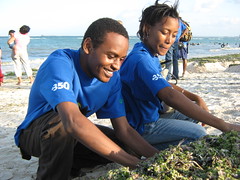
Indeed it is these systemic complexities and inequities that most plague the path to agreement in Copenhagen. But there is nonetheless climate solidarity that transcends national barriers, as evidenced by the massive global call to action organized by 350.org on October 24. As I wrote recently, solving climate change has great potential to serve as an organizing principle for Green Diplomacy, in a way that solves geostrategic, security, and development concerns. But it also has the potential to be a Global Green Stimulus, at a time when developing countries have been further battered by the financial failures of rich nations. Administering much of this stimulus in the form of mitigation grants or an adaptation fund is key to answering the major questions of global environmental justice.

[Photo credit: 350.org action on the beach of Dar es Salaam, Tanzania (CC).]